





Folder highlights
Transcripts detail ‘Closing Time’ episodes featuring GTM leaders discussing topics like AI in sales, LinkedIn strategy, and pipeline velocity.
You’ve got a yes.
And now it’s time to negotiate.
Let’s talk about ways to make this stage a success for the buyer
and the seller in today’s episode of Closing Time.
Thanks for tuning in to Closing Time, the show for go to Market Leaders.
I’m Val Riley, head of marketing for Insightly, UnBounce, and LeadsRx.
Today I am joined again by the wonderful Todd Caponi.
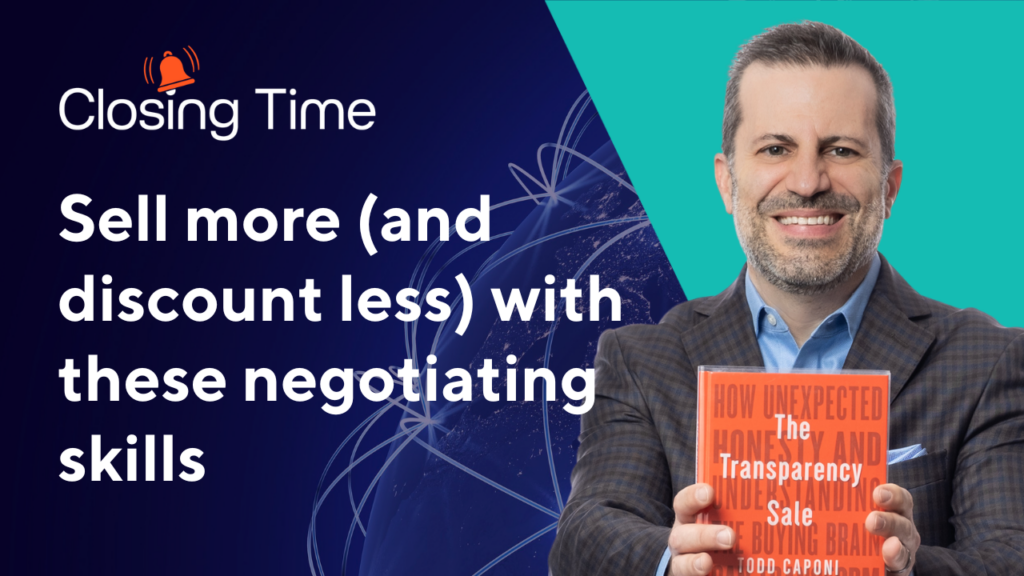
He’s a sales consultant, author of The Transparency
Sale and the Transparent Sales Leader.
And today we’re talking about his latest book, Four Levers Negotiating.
Todd, welcome back.
It is so good to be back again.
What is this, number six?
We’ve got a big number already,. It’s a big number.
You’re a fan favorite.
And so we were always looking for reasons
to talk to you, and we heard you published another book.
And so great reason to have you back.
Let’s talk about the book.
I understand you were inspired to write the book
based on a real life million dollar deal that went well.
Yeah.
And actually, you just kind of triggered it when you said we’ve gotten a yes.
Now it’s time to negotiate.
And so here’s the kind of the gist
on all of this is back when I first got promoted
to being SVP of sales,. I was a terrible negotiator.
And it really came from this concept, the idea that
why is it that we need a different personality
once the customer says yes,
when we have to negotiate than we did to sell the deal, right.
Like sales is supposed to be about you’re building a relationship
with a focus on helping customers achieve optimal outcomes,
and we get them all the way to the goal line.
We’ve built all this trust.
They said yes. And then what happens?
Well, at least the way that I was taught was
we start lying, even a subconscious level.
We don’t tell them what a good deal is.
And in many cases, we’re learning techniques and approaches
that are taught by former. FBI hostage negotiators, like I.
That always felt weird to me.
It never worked for me.
And then I’m a believer of two things, and then I can tell you the story.
But, you know, number one is we’ve got to remember that in today’s world, the
as a service world, the deal is no longer the peak of the relationship.
It’s merely an early milestone on the path to having customers that not only buy,
but they stay, they buy more, and they advocate for us
and hopefully take us with them to the next company.
But number two issue that I see is in this world
of the proliferation of information on everything we do, buying experience,
peer connections,. AI exposing pricing models,
I also believe that it will be no longer sustainable to have every customer
paying a different amount based on how well or poorly the negotiation went,
and that kind of led me to this back in 2008.
The story which we can talk about in a minute, but I’ll take a breath there.
That’s my kind of opening rant on the why behind,
gosh, traditional negotiating approaches.
I don’t think they’re sustainable.
You know, I’ll relate the story before you relate your story.
I can remember I was early on in my career
and I had agreed to accept a new position,
and then we moved into the negotiating phase.
And a sales person friend of mine said, you realize now it is their job
to get you in at the lowest possible rate that they can.
And I was like, wow, this is suddenly adversarial.
Like it was all love and fun and come work for us.
And then it was like a switch flipped and it became a push and pull.
And so I believe this type of negotiation, personality changes.
I think it happens in all areas of life, but specifically, obviously in sales.
Yeah, if we’re taught that way.
Right, that if our focus during the sales process is on the customers outcomes,
helping them achieve optimal ones, the minute that yes comes across,
we then focus on our own optimal outcomes and we no longer care about those.
And I think it’s crazy that we continue to do this
right at the goal line, where trust is most vital.
We’re going to to make a commitment we’re about to sign or about to part ways
with our budget, our money, our resources, our time.
And we’re lying to each other and we know it and we’re playing games.
And I just don’t think that that’s sustainable at all anymore.
So tell me about this million dollar deal, because it sounds like
it was a it was a turning point for you and a real inspiration.
Yeah, it was accidental.
I had so I was I had just been promoted to be SVP of sales for a
SaaS type of company back in 2008, and the deals we did were huge.
But this framework applies to the smallest,
to the small, to the biggest to the big.
What had happened was my sales rep was working on this deal,
and it was a $2.5 million a year for three year deal.
So significant.
And the procurement people and again, with this framework,
you can share it with everybody doesn’t have to be procurement.
This one so happened to be procurement.
They had asked them my rep for something.
And my rep was like. I gotta go call my manager.
And they’re like, all right, listen,
whoever this manager is like,
let’s get in the room with this individual right now.
And so I got called down to Houston, went into this room
with my rep and this procurement guy, or so I thought.
Turns out they brought the whole procurement team
and it the multibillion dollar company.
So a couple million bucks
a year doesn’t seem like much, but they fight for every penny.
There’s a reason why they’re so successful.
I immediately knew, again, being a terrible negotiator,
that I’m about to get boat raced outta here like this is going to be a disaster.
Now, what had happened, though, is a couple of days earlier,
I was at our headquarters in the Valley, and I was sitting down with my CFO,
and he happened to share something with me that I thought was interesting.
It was basically the core drivers of our business model.
There’s four of them.
And so what had happened
was when I went into this room,. I started that
sweat and wheels started turning like, oh no, what am I going to do?
I decided to basically buy some time.
I walked up to a whiteboard that was behind them and said, hey, before
we get started, can I share the drivers of our business, the things that
actually our pricing is based on?
But really our whole organization is driven by
and they were like, whatever dude that gave me,
there’s a pen there, completely indifferent.
But I wrote four things on the whiteboard
and those four things became the four levers.
So here they are for everybody.
So you don’t even have to read the book if you don’t want.
But I think you want to.
So, number one driver,
and this is for every B2B for profit company in the world by the way.
So everybody listening these are your drivers too, your levers.
Number one is volume or how much they buy.
Meaning the more stuff they commit to products technology, services,
licenses, locations, whatever it is, the better it is for us, right?
Commit to more. Better. Commit to less.. Not as good.
So volume is number one.
Number two is the timing of cash or how fast they pay.
Faster they pay, better.. Slower they pay, not as good.
Number three is the length of
commitment or how long they commit to our products, technology and services.
So commit longer, better.
Commit shorter, not as good.
And then number four is the timing of the deal or predictability.
There’s value in every organization’s ability to forecast
not only from an investment perspective, but also
for deal like this required resources.
Our ability to predict and align around that timing was valuable.
So we knew who needed to be available when and where at the right time.
I wrote those four on the board
they were completely indifferent to like, hey, nice penmanship.
I think that was maybe what they said.
And then they completely ignored it.
And immediately asked for a 30% discount.
They said, hey, due to budget issues,
we want to get going, but we got to get 30% off of this.
What do you do?
Well, some people will teach you to start
playing the word art games of FBI hostage negotiating.
I, I was terrible at that.
I’m not going to be that they touch their nose.
They’re lying. Like that kind of stuff just didn’t play well with me.
You could go into the value argument again.
I wouldn’t recommend it.
I think that ship’s sailed, meaning
we believe our technology worth X, like that’s dumb.
Stop it.
Or number three is we just start giving stuff away, right?
Like 30%.
Hey, I can give you 10%.
I don’t even have to ask anybody.
And now we’ve just started that race to the bottom.
Instead, what I did was I stood up and said, hey,
remember those four things that I wrote on the whiteboard?
Maybe we can use those as a guide to see how close we could get.
And I started working through each one of the levers one by one.
Because those four things, as it turns out, are the four things
that we’re willing to pay for in the form of a discount more volume,
faster cash, longer commitment, predictability.
That’s it.
So we ended up going through the whole thing.
They ended up paying us faster.
They paid for the whole three years upfront, which was awesome for us.
We were kind of a mid-level company.
It avoided our need to go get another round of funding
and they mutually aligned around timing.
We can talk about what each one of these things are,
but they actually signed on time, and we paid them in the form of a discount
to help us predict.
So that was the story.
There was some other stuff that happened afterwards that we had to negotiate,
of course, but the levers work perfectly for that.
Of course we can discuss too, but in the end we built
trust cards were played, faced up.
They not only pulled and pushed their own levers,
but they used it for their upsell,
the cross-sell and the renewal, and they remembered them.
And that’s really the point.
Consistency, sound basis, pricing,
but with flexibility within the things we’re willing to pay for.
And that’s really the magic of four levers negotiating.
So what I really like about that story,. Todd, is that
you never know where a business is
and what levers
are easier for them to pull and harder for them to pull.
For instance, maybe a business is flush with cash
and so they they can, you know, pay up front.
Or maybe the business is looking at, they have
they’ve just received funding and they have like a six year runway.
So committing to a three year deal is not a pain point
versus another business who is in their fifth year of funding.
Committing to multiyear would not be comfortable.
So essentially you’re sussing out and you’re saying,
hey, which one of those which one of these things
or two of these things or even three of these things.
Do you have flexibility?
And it’s really hard to know that without just kind of
putting your cards on the table and asking.
Exactly.
That’s the magic of this thing.
And say, hey, here’s the cards.
And oh, by the way, your company also is driven by this.
This was an oil services company in Houston.
They want customers to buy a lot of stuff, pay fast, commit to a long time
and be predictable in terms of when they’re going to be out
laying the cash, needing resources, etc.
so those are the four.
You just throw them face down on the table and go,
hey, push and pull whichever ones you want.
The funny thing was in 2008, for anybody listening who’s old enough,
oil services,
Schlumberger was the company.
They had like $17 billion of cash on their balance sheet and procurement,
as it turns out, didn’t care about the outlay
of when cash was spent, like they want the discounts.
And then we got them to pay three years upfront.
They wrote us a check for like $6.5 million, net 30.
We didn’t have to go get another round of funding.
Like, how awesome is that again?
They got what they want, we got what we want.
And that became that sound basis by which they one of the core things of
this is we’re trying to build confidence in our pricing model, too.
The minute we walk in and we go, here’s our proposal.
And the minute they start asking for things like, hey,
we require net 60 payment terms, you’re like,
we can’t, we can’t do that, but we can do net 45.
Now you immediately told them that your price isn’t your price
and open the floodgates to them asking for more.
So to your point, the cards are consistent, they’re face up.
You pull and push whichever ones you want.
That’s the consistently level.
But that’s what our price is based on.
We’re not a startup.. We’ve got customers paying.
Use the cards to do it the way you want.
We’re going to be happy either way
and that’s where all of a sudden, instead of a customer vendor in that room,
it was a bunch of us sitting around a table going, how are we going
to make this work for each other to where they’re making a big investment.
They want us to be successful.
They want us to be an ongoing concern, but they obviously have some metrics
and things that they wanted to get out of it as well.
You know, in our business, in the CRM business
and the landing page business, we have assisted deals,
that we bill out and get net 30, and then we have our self-serve business,
and our self-serve business requires a credit card swipe to check out.
And in some ways, that is so simplistic because you take out the negotiation,
you take out the terms, we get our money immediately.
So it’s like sometimes context switching between our assisted business
and our self-serve business is interesting because you take out
the self-serve business with the credit card swipe, just it’s
smaller deals and it’s higher volume, but it just takes out all of that
uncertainty and lets us put our negotiating hat on the shelf.
Exactly.
I mean, I’m
assuming that you probably reward a client for committing to more volume in that,
and you probably reward the client for committing to longer terms in there, too.
That’s what we’re all doing.
And to your point about the credit card swipe,
you know, one of the things that I just think is kind of funny is if you went,
did you go grocery shopping or you go, go to a store, go to a restaurant,
go to a gas station like you don’t put your card
up to the cashier and go,. I have a budget issue.
I need a discount.
They would be like less buy, buy less stuff.
Like, what are you talking about?
My payment terms are net 60, and they’re like,
no, you swipe your card right now and you take it
or come back in sixty days like that.
We don’t question it.
We don’t think about negotiating it.
That’s B2C.
I just believe that in B2B we’ve created a sound
basis problem and that sound basis.
I keep using that phrase that’s actually from a quote from
one of my books behind me from 1910, from Thomas Herbert Russell.
This book is called Salesmanship. Theory and Practice, and in it
he has a quote that essentially says buyers
know more nowadays, but they know that the price
isn’t the price unless they believe it is based on something sound.
So the he calls it some sound basis.
We’ve established that sound basis.
Confidence becomes contagious.
They know what the levers are and we stop being in the business of charity,
which is discounting in the form of charity to the customers bottom line.
But I just don’t believe that sustainable.
It’s so interesting that you talk about, being transparent pricing.
I worked for a SaaS business that didn’t publish pricing on its website,
and in order to see our pricing, you had to take a demo.
And it kills me now because it wasn’t that long ago.
I mean, I do have some gray hair, Todd.
It wasn’t that long ago, but nowadays that tactic just doesn’t exist anymore
because you can go to AI and you can ask, hey, how much does this cost?
And AI is going to put a guess out there.
It may or may not be right, but it’s got it’s going to give you an answer.
So this idea that we can veil our pricing and require
something in order to see it is, is really just going away.
Right.
Yeah, I, I believe that the term sticker shock has never been associated
with anything good in the history of humankind.
Right.
And this idea that we can hide the price and build up enough value
to where they’re willing to pay anything, like we just know that’s not true.
I’ve always been an advocate for when we engage with a potential customer
starting the conversation,
especially if we think that there might be some misalignment there.
Starting the conversation
by just saying, hey, now listen, before we get too deep into it,
based on my understanding of your environment and what you’re trying
to achieve, your investment is probably going to be between X and Y.
And if that’s way off of your expectations,
let’s talk about that now before we get too deep into it.
I know we’re higher in price.
And hopefully through this journey,
we’re going to show you why we’ve got a bazillion customers that are paying it.
But if you don’t have an appetite for that, let’s address that now.
Right?
If you’re talking about a six figure solution to a four figure
buyer or vice versa, one of you is in the wrong conversation.
Don’t you want to know that now?
Don’t you want to set that expectation?
And don’t you want our brains we file?
Is the juice going to be worth the squeeze?
Every word that comes in a value and all that kind of stuff.
We’re trying to hit it against
what is going to be the outlay of my time, resources and money.
And does it match up?
There’s a reason why,
when we’re buying stuff online, all of you listening, you skip
the five star reviews and read the fours, threes, twos and ones first, don’t you?
Why do we do that?
Because we gotta understand the downside so we can match up the upside against it.
I believe price is a blazing example of we got a set of range.
Doesn’t have to be perfect.
Set that range.
Set expectations early because again sticker shock is not a good thing.
And if you’re trying to create it,. I would highly advise against it.
Right okay.
So we’re not hiding prices anymore which is good
because it was a strange practice even when we were knee deep in it.
So you talked about a lot of ways
where today’s buyer has changed.
Right. They, they have more maturity.
They have more knowledge.
They’re probably farther along in the journey.
So those are things that have changed.
Is there anything that you can identify that really hasn’t changed?
Because I noticed you quoted a book from 1910.
Well, yeah.
I mean, I would argue that in terms of buyer
information availability, it hasn’t really changed the buyers.
It just changes the lens by which we should be service professionals.
One of my favorite sales books of all time is 1911
the Art of Selling by Arthur Sheldon.
And in it he’s got a quote that says, true salesmanship is the science of service.
Grasp that thought firmly and never let go.
What does that mean?
It means that back in 1910, Thomas. Herbert Russell was talking about the fact
that buyers knew more nowadays
and that was a threat to the sales profession, meaning
the rise of mail order catalogs.
I’ve got a 1908 Sears Roebuck catalog that’s like Amazon in printed
form back here.
They were worried about advertising and what would we need salespeople
for anymore?
I would argue over and over again that more information has never made it
easier on buyers.
It has always made it harder.
And our role is to a, do the homework,
but b, set proper expectations that we can consistently meet.
And if we do that through the lens of providing a service to the buyer,
that again, if you’ve got four figures budget
and I’m selling a six figure solution, why are we wasting each other’s time?
Or this is something that’s really going to address a big corporate issue.
Maybe I can turn you in a coach that we can go develop this thing.
Otherwise, for me to argue all day long and turn you into a six figure buyer
when that’s never going to happen, that’s a crazy waste of time.
That is not providing a service, that is not doing the homework for the buyer.
Awesome. Todd, this has been a great conversation.
I really do feel like, the information you’re sharing
is going to make the negotiation phase just a lot more efficient,
but also just a lot more pleasant throughout, you know, as, as a buyer, as,
as I’m thinking through that negotiation phase, I just
I want it to be a little less adversarial.
And I feel like that’s what you’re setting us up for with this book.
Yeah, exactly.
That’s what it is
when you think about every single thing that comes up during a negotiation,
you can absolutely go back to the four levers they ask for discount.
You can take them back to it.
They ask for net 60 payment terms.
They want to have you hold the price the next month.
They want termination for convenience.
They want to do a pilot.
There’s so many things that when you just go back and go, cool, here’s
what our pricing is based on.
Let’s go through it and see if we can get you a little closer to what you need.
That doesn’t mean we’re saying no.
That doesn’t mean we’re being jerks about it.
It’s, hey, this is the model.
These are the things.. And you can move them around all you want.
There’s a book from 1921 that has my favorite sales quote of all time.
It’s from Arthur Dunn.
The book is called Scientific. Selling and Advertising,
and the quote is simply this if the truth won’t sell it, don’t sell it.
Right.. And that should be your pricing model.
We should be walking in with confidence.
Our prices, our price.
With this flexibility within the four levers, you gain consistency.
You build confidence and your customers will not only use it,
they will use it for renewals, upsells, cross sales and they’ll take it with them
to their next company.
that’s the gold, right?
When when we when we have the client, we sign them that they’re happy,
they renew, they upsell, and then, like you’re saying,
they go somewhere else and they’re like, yeah,
we should just go ahead and buy these guys and we get that referral proof.
That’s the way it should be.
Todd, thank you so much for joining us today.
Thanks for having me.
This is such a fun topic and you can tell. I’m a little bit passionate about it.
I can.
Where can folks go if they want to preorder the book?
Because I understand it’s not quite available just yet.
Yeah, it comes out January 27th, 2026.
It is available right now
wherever you buy books, including digital and the audiobook.
Awesome.
I also recommend Todd.
He’s a great follow on LinkedIn if you want some good sales
coaching and some good sales history mixed in there too.
And thanks to all of you for joining us on Closing Time.
Remember, you can get this episode and all of our episodes delivered
right to your inbox
if you click that link in the show notes, we’ll see you next week.