




It’s time to kick off new budgets and campaigns.
You’re deciding
what media to double down on and what paid media to maybe leave behind.
Let’s kick off paid media in 2026.
On today’s episode of Closing Time.
Thanks for tuning in to Closing Time, the show for go to Market Leaders.
I’m Val Riley, head of marketing for Unbounce, Insightly and LeadsRx.
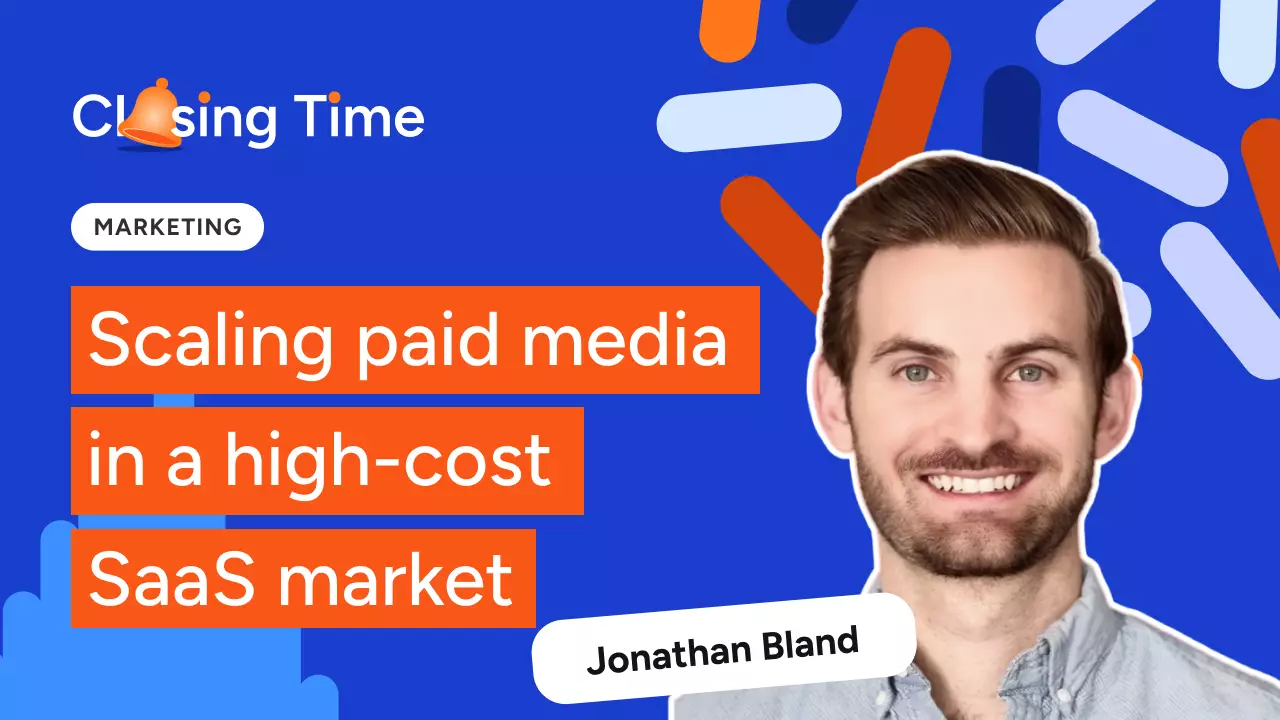
Today I’m joined by Jonathan Bland.
He’s a seasoned paid media strategist and co-founder of Omni Lab.
Jonathan, welcome to the show.
Thanks for having me.
Awesome.
So let’s just dig right in.
I wanted to talk a little bit about seasonal pricing dynamics
and how they play parts in the paid media game.
For example, what trends did you maybe see towards the end of 2025,
and what can we expect in Q1 of 2026?
And I’m particularly interested in platforms like Google Ads and LinkedIn.
Yeah yeah yeah. I mean I think we saw a lot of expected
behavior to some degree depending on how, you know, much is spent on paid media.
But generally speaking we see CPCs and CPMs get inflated
and spike around the end of the September beginning of September timeframe.
When we were looking at data, actually pulled some, some stats
right before we got on.
And I was looking at every
one of the clients and brands we work with in the SaaS space,
and we saw CPCs averaging around $3 at the beginning of 2025.
And they’re now upwards of 13.
Again, these are averages, right?
We know that a lot of high end in terms are much more expensive than that.
But if you average everything out,
obviously a huge, huge increase just from a CPCs perspective.
And I think we can all agree like. I mean, well, it’s a leading indicator
and not something that you theoretically report out to a CEO.
All of those things impact downstream conversions.
Right?
So you’re looking at cost per year, right?
From a SQL perspective, cost per op.
CAC, the whole nine yards.
And so we really need to keep an eye on those things.
So that was a big thing.
And I think a lot of times this happens because of course,
you know, we’re all trying to find ways to, you know, meet end of year goals.
And we may be behind.
And if we’re behind, then we often throw a lot more budget behind
something and say, hey, great, we’ve got to spend more dollars.
Or two.
We’ve got just extra budget left over.
We want to spend it.
And then there’s the third, which is, you know, we know a lot of people
a lot of times are either coming up on a contract,
and they’re thinking about new vendors, new solutions, new things that are going
on in the market for next year because they’re in planning mode.
And so it can be a great time to ultimately get people into a mode
where they’re evaluating software and looking at,
you know, looking whatever company you work for.
love the fact that you use the example of, you know, hey, this might be something
to elevate to the CEO or might not, because I have seen this year.
And basically over the past 5 or 6 quarters, you know, CPLs
is just getting to the point where it made our funnel just, you know, stop working.
Really, for lack of a better phrase.
And, I did something. I did have to elevate to the CEO and said,
you know, this is this is why the funnel is is, is struggling in general.
And I just feels like Google
just keeps on raising those prices and saying, well, it’s demand.
But, there’s a point at which
some companies just really can’t afford to play the game anymore.
Yeah, I think there’s that.
And then, of course, we know that everything
that’s happening, from an AI perspective,
AI overviews have led to huge decreases in click through rate.
And so a lot of top of funnel traffic that we all used to get to our websites
via those types of searches just isn’t there anymore.
And so people are a lot of times go into LLMs where they’re
getting those answers directly from AI overviews or now AI max.
And so I think I don’t have data confidently to say this,
but it seems pretty obvious what’s going on.
You look at just general cost structures
and also patterns across a lot of our clients are working with that.
A lot of people have moved budget
from lower int in terms to higher content terms over the last year or two.
We’ve traditionally
always been focused on high intent, and I think it’s not a new thing per se.
But when you start to get budget consolidation on terms
that just have simply less volume, like cybersecurity software
versus cybersecurity or other general terms,
or what is cybersecurity or how do I get protected?
You know, clearly you’re going to get increased costs
from that, you know, as you’ve got more competition on it.
So I think there’s that.
The other thing, too
is say one last thing on it is that you’ve got also privacy
regulations getting tougher and more stringent as well.
And I think tracking has gotten more difficult,
you know, and you can already see from vendors like cookies and others,
acceptance rates on cookie consent forms and so that
those are really, really important to sending data back to Google.
And so I think oftentimes if you’re only leveraging in platform data
to look at cost per or frequency metrics,
they can honestly be a little bit misleading from a conversion perspective
because you’re not capturing as much data as you were before,
especially with European types of campaigns.
So some other things to consider as well.
But yeah, it’s it’s definitely tough out there.
On Google, there’s no doubt.
So you mentioned, the high intent terms versus low intent terms.
Is that how you’re coaching clients in terms of what
you’re moving away from for 2026 and what you’re embracing?
Or are there other things that you’re seeing that you’re,
that you’re looking at as your clients look to invest in the year ahead?
Oh 100% I mean, we’ve been,. I guess, doing this agency
for the last 5 or 6 years
and pretty much since the inception, it’s always been high intent.
So that’ll always be our line, related to Google Ads, simply because
usually Google is used as a bottom of the funnel
channel, and people see it as more direct response performance marketing.
And so we don’t want to spend a whole lot of budget on terms
that are more built around awareness
and instead shift that budget over to social channels.
So, yeah,. I would always advocate, to invest
as many dollars on the high intent side, either non brand
or competitor before doing anything on the low intent side.
But there is a reality that the economics potentially
might not make sense for that brand.
And so there have been some instances too, where we’ve had to walk away from Google
as a channel.
It’s just simply too expensive based upon the pricing model of the brand.
And they can either decide to make a pricing decision and
reprice their products so that CAC gets, you know, and more aligned with with LTV.
Or they simply say, hey, there’s other channels where I can reach
my audience more effectively, and Google’s not one of those.
And I think it’s really good
to be agnostic from our side where. I’m not attached to Google by any stretch.
We just want to find the best channels that ultimately work and drive
the best efficiency.
But, you know, again, Google’s Google and, it’s got the intent versus
any other channels.. So it’s sometimes tough to pull away from.
Yeah, I would say I think every paid media manager, every CMO
looking at the budget for 2026 has had, has had that thought, like,
is this a channel that we really need because it is getting exorbitant.
But let’s let’s talk about something a little more fun.
Let’s talk about creative.
Are are there trends that you’re seeing in, creative or paid media
specific formats, messaging or approaches that, we can look for in 2026?
You know, I’ll say something
that I think, is top of mind for,. I think a lot of people,
but I think far less are actually doing it.
But when we talk about LinkedIn,. I mean, we’ve all heard of thought,
thought leader ads for a lot of us have great organic posts, that are promoted.
They are still the number one,
ad format for us, not only as an agency, but for all the brands we work with.
Engagement rates are 5 to 6 times
anything that you would see on any other type of ad format.
And oftentimes the conversion rate is even better than sometimes the other formats.
And so,
you know, we, we have a huge pull for any brand
that we work with where, hey, we need to have at least a handful
of thought leader ad campaigns running because it’s a native look and feel.
Right?
I that’s what people are used to engaging with when they get on the news feed.
And so when they start scrolling, looking through things,
it’s a natural thing to engage with a human versus a company.
And so I think that’s why they get such great engagement.
But also they put a face next to the brand.
And I think often brands want to hide behind the logo
and, not get someone out there into, into the world,
that actually represents the brand.. It doesn’t have to be the founder.
It could be an SME, or it could even be someone external.
But that’s a big one. Thought leader ads.
I did pull some data,
and I was looking at it earlier because we pulled literally all 2025 data.
We’ve been doing some look backs on all ad formats.
The, the CTR in terms of best
CTR is still seeing that single image ads, hands down 2.72%.
And I think it’s also one of
the most popular use formats because it’s the easiest to get going on
and then the best conversion rate, which actually surprised me
a bit, was carousels, 2.96%, which, didn’t make as much sense to me.
I mean, carousels are not used as much, and often they’re typically formats
that are a little bit better for in channel consumption,
where people might swipe through something.
But, you know, we still found that they performed a lot better in this again
is aggregated across all conversions, not just high intent but also low intent too.
So those are two things, at least that we’ve seen from that.
For my perspective.
Nice.
Got to put that, carousel on my list. I think.
And I, I do agree with you with the thought leader ads.
It does feel often that you’re, you often don’t realize you’re consuming an ad.
And I think that’s what makes it so,
such a positive experience.
But also, it doesn’t it doesn’t feel like, like an exchange at all.
It just feels like I’m.
I’m learning, I’m growing,
and I’m, I’m doing that within LinkedIn, which is what I’ve come for.
So, excited to see how more people can work those into their mix.
You said something really smart there at the end, which is, Why
they’re coming to LinkedIn, why they’re logging in.
I think that’s really smart, because I think often,
you know, we’re in this mode of we want everyone
to demo or sign up for a product or start a trial, whatever the CTA is.
But the reason that people come to. LinkedIn is not to evaluate software.
I mean, no one has the mindset of, hey,
I’m looking for something, or they don’t type into the search bar,
you know, cybersecurity platform or whatever the product category is.
They’re looking to learn something new, to connect with friends, to engage with,
stuff, to waste time between meeting, look for a job, I mean, things like that.
And so I think to your point, you know, a thought leader ads,
knowing the intent behind why the person is even on the platform
is one of the reasons that thought leader ads get more engagement.
Because generally speaking, at least most of the posts that you know
we’re promoting in, 99% of them are not direct response like,
hey, we do audits, get our audit for free type of thing, click the CTA below.
It’s much more narrative based.
Talking about the problem.
You know, practical tips,
tricks like things like that that are actually legitimately helpful.
So I think it’s a really good point.. You mentioned there.
So another question that many brands have. I’m sure you get asked
this all the time when you are engaging with a client with a new client.
How should they, how much should they be doing monitoring
what competitors are doing
and and learning from what competitors are doing on paid media.
And are there specific tools or practices you have around competitor
paid media monitoring? Right.
This may be a bit controversial, but at least in the paid
sphere, I’m not a huge proponent of doing a lot of competitor research.
I think
when you think
about competitor research from a positioning or pricing perspective
or just understanding who’s in the space from a product marketing,
lens, clearly,. I think there’s advantages to doing that
and understanding how your competitors are positioned themselves against you.
But as it relates to paid,. I think the focus really
should be on the customer at the end of the day.
And, a perfect example is,
you know, we know there’s spy fu and hrefs and other tools like that out there
where you can clearly do keyword research,
and that would be a common thing for someone to say, hey, Val,
can you tell me who’s you know who. XYZ company’s bidding on?
Maybe we should bid on those keywords too.
And I think directionally it can be somewhat interesting.
Maybe there’s some opportunities that you missed out on,
but honestly, we don’t know how those keywords are performing.
One, they could be wasting tons of money on them and they may not be a perfect fit.
We don’t really know if the ICP is exactly aligned with your ICP.
The stage of company. I mean stage of growth
and where they are as a company might be different than you.
They also might not even be intentionally trying to bid on those terms.
They may have someone
that’s not managing the account, whether in-house or out of house.
Well, or maybe there’s broad match being used
or something like that on Google or an AI based campaign type.
And so you’re looking at all the the juicy details
and saying, wait a minute, they’re bidding on XYZ.
I mean that that may be something we should go after.
So I think things like that. I think are directionally interesting.
I just wouldn’t put a lot of faith in them at all.
And I think it’s really better to focus on and say, hey,
how are customers describing our product?
What are they saying on sales calls related to problems
or different capabilities are looking
for, like, what are the words that they use to find our stuff?
I think that’s way more impactful because you’re going to better align
with ultimately how the customer searching what they’re looking for
and then obviously be really locked in to, you know, your ICP versus
someone else’s.. That’s always been my philosophy.
I’m glad we’re aligned there.
I always call it keep your eyes on your own paper
because it might be interesting what’s going on over there.
But there’s a lot behind that that maybe we don’t know.
So Exactly.
It’s interesting.
It’s no doubt interesting
So I wanted to go a little bit deeper on two, specific angles
because they both happen to be present in the organization that I work for.
And so first. I’d like to talk about Insightly,
which is a CRM, CRM, perhaps the most competitive
SaaS category that there is, long term players, big budgets.
And so there might be other people listening who are in the same position
as Insightly that we are a challenger brand in a very competitive industry.
So when you’re approaching a client that is a challenger
brand in a highly competitive space, what are some typical approaches
that you have that can help them have success in paid media?
First thing I’d say is don’t do what other big brands do.
Is as a general rec.
I mean, we love to look at big dogs of the, the software SaaS world
or wherever, whoever the category leader is and say, well, they’re doing it.
It must be a good idea.
But the you get, you’ve got to be different somehow.
And, that could be maybe a different capability, a different pricing structure,
could be, just a different segment that you’re going after.
What I found and something interesting.
I saw an ad, just last night on Instagram, and it was,
something like AI, agenetic
platform for everyone or for something broad.
Like that was the headline.
And, you know, my takeaway from it was.
All right. Great.. I don’t know really what it does.
I. Yeah, okay.
AI agenetic. I don’t know really who it’s for.
And and so you kind of come away with that thinking our idea.
Great. It’s just another, you know, broad based ad.
I think the example. I would think about with Insightly
as compared to HubSpot and Salesforce is, I mean,
those are the juggernauts of the CRM space, clearly, and they’re going after
pretty much anyone and everyone.
HubSpot may be leaning a little more SMB,
mid-market, Salesforce lending a little bit more enterprise.
But for me, for you all or for any brand that’s, you know, obviously,
you know, not the category leader per se, or the first name that comes to mind is
how do we get more specific on messaging, whether it be through advertising,
our website, or specific pages that relate more to a segment
that’s potentially underserved?
And so, you know, Salesforce has obviously a lot of people working at it,
but I’m sure they’re underserved markets where you could come in
and have a more prescriptive solution or module in your product
that better serves that market that’s just not being met.
And so you could learn about that
through reviews on G2 and capterra or Reddit threads.
There’s other tools and platforms that aggregate this information together
where you can get some of those insights,
but for me would be like, how do we get more specific?
Because often,
I mean, most of the ads and even things
on, you know, their landing pages are so general.
It’s like, you know, a CRM that works, a CRM that drives
revenue, a CRM that, you know, so on and so forth.
And so again,. I think like getting specific
and getting really, practical on the use case
really opens people’s eyes to saying, oh, wait a minute.
Oh, this is for me.
So I think that those are some of the ways that I would think about standing out.
And that rolls up to your, creative question messaging question.
Two same exact principles apply there.
And let’s look at the other side.
So we also have the Unbounce brand on Unbounce landing
page builder, brand leader category leader.
Almost synonymous with landing pages.
So the strategy differs quite a bit when you’re approaching a client
who is leading the brand.
Can you talk a little bit about that.
Yeah, I mean, it it’s not often you’re in that position.
So often
we’re always battling the category leader
because there’s so few right for each category.
But yeah, I think,
I mean, ultimately you’re in a position of defending, you know, brand and staying
top of mind and being competitive against other people that are out there.
And so for me, it’s really just doubling down on existing messaging.
You’ve got probably more resources and more budget that a lot of the smaller
brands do because you are the first brand that comes to mind.
And so for me, it’s about maximizing mental availability
and the minds of people that are out of market
because you now are already top of mind with lots of people.
But there are now other options.
And so it’s really about how do we continue to stay top of mind
and maintain market share, because we know that people can forget,
new brands are coming up, they’re going to be spending more money
trying to find creative ways to upend. Unbounce and get you guys out of the way.
And so for you all, for me, it’s how are you guys staying innovative
and what are you offering that’s new, great
and exciting that we should get excited about.
And then, you know, how do we get really clear on the offering
and stay top of mind in a really memorable and emotional way so that again,
when they do have a need for a landing page builder, like Unbounce
and all the other things it does, they’re thinking Unbounce only,
or at least they’re in the top three consideration set.
So yeah, it’s definitely a different, different game.
I mean, you have the luxury of, you know, making, I think a lot more mistakes.
When you’re in that position, you know, when you’re an upstart brand and you’re
trying to, you know, make a name for yourself, I think it’s much harder.
Marketing is a totally different game, but I’d be curious of your thoughts, too.
I mean, you’re in that world way more than I am.
And I think often we’re
working with brands that are not the sales forces of their category,
and so it’s much easier to answer the latter.
But any anything that you found that is more effective
or things that you guys are focused on for 2026, I’d wonder.
I will tell you the theme for our team.
And we’re a pretty small marketing team with both of these brands, right?
This challenger brand and this market leading brand.
And so the theme is definitely just context switching all day every day
as we’re working on campaigns for Unbounce,
we have that lens that you just mentioned.
You know we’re defending we’re talking about our new features.
We’re, you know, reinforcing that you’re making the right decision
by going with the market leader.
And then we change our hats very quickly.
And, you know, as Insightly, you know, it’s a it’s
kind of fun being the challenger brand sometimes
because you can punch up a little bit, you can, you know, make a little fun.
You can be a little edgy.
You can be a little a little bit more creative.
You have a little bit more leeway.
So in some ways, being the challenger brand is a little more fun.
And and being the category leader can be a little bit, a little bit.
Your hands are tied a little bit more.
So, without giving away too much of the secret sauce, I might leave it at that.
So Jonathan, thank you so much for your time today.
If folks want to learn more about you or Omni Lab, where should they go?
Easiest places. Type in Jonathan Bland on LinkedIn.
I think I’m one of the only ones.
But Omni Lab, if I, if there’s two or multiple out there
and then Omni lab consulting.com is, is where you can find us.
We do paid media for SaaS brands, ad creative and even conversion
tracking analytics to get everything wired.
And we’re really focused on also making sure that we drive pipeline for the brands
we work with.. So yeah, that’s where you can find us.
Thank you so much.
I will just I’ll just reinforce our our conversation on our pre call
was so insightful.
So really I, I was incredibly impressed with your understanding
of SaaS in general and paid media for SaaS. So definitely check Jonathan out.
He’s a great follow on LinkedIn.. Thank you, thank you.
Appreciate that.
And thanks to all of you for tuning in to this week’s episode of Closing Time.
Remember, you can get this episode and every episode delivered
right to your inbox
if you click the link in the show notes, and we’ll see you next week.