




Is 2026 your year for a bold career change?
Let’s talk about big moves
and why sales might be one of the best career paths out there.
In today’s episode of Closing Time,
welcome to Closing Time, the show for go to market Leaders.
I’m Val Riley, head of marketing for Insightly, Unbounce, and LeadsRx.
Today we’re kicking off the year and talking about bold career moves.
With economic uncertainty looming, you may be looking at a career change.
We’ve talked a lot on this show about sales careers, the benefits,
how it offers, flexibility,
growth, income potential, and the ability to chart your own path.
This can be especially attractive for women who currently
only fill about 32% of sales roles.
So to talk more about career reinvention in general, and specifically
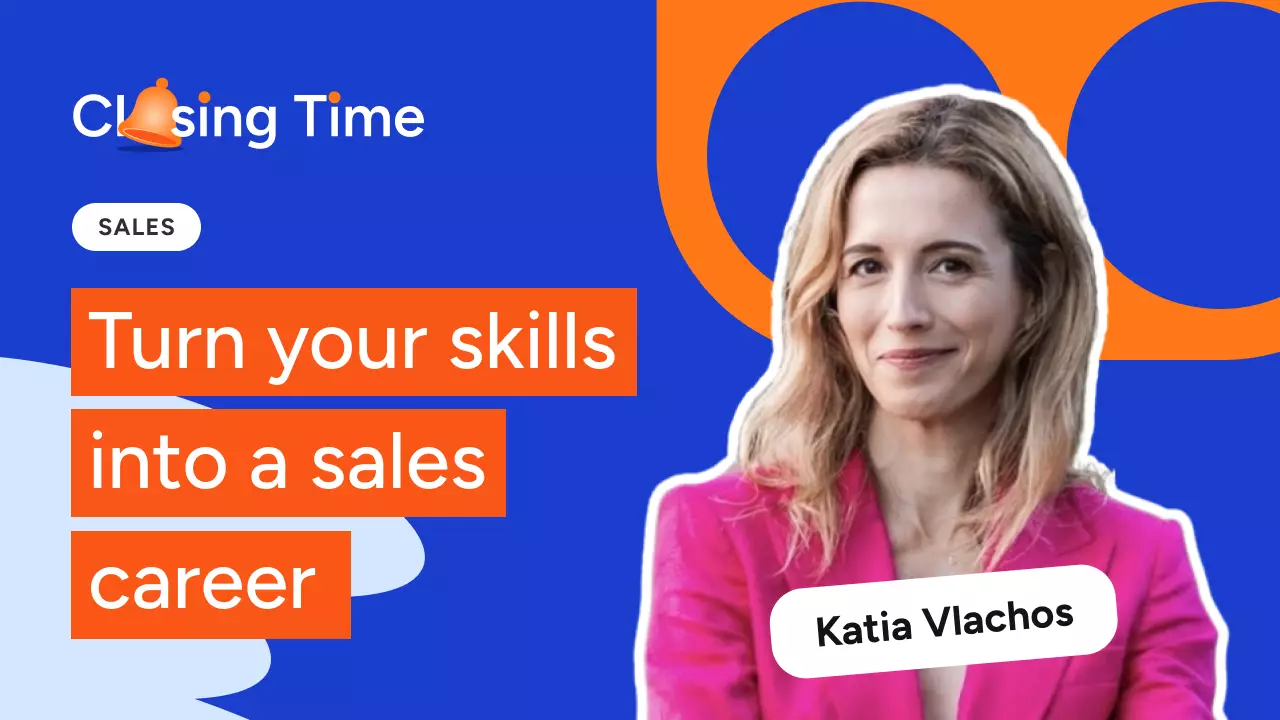
a little bit about sales, we’ve invited. Katia Vlachos to join us today.
She is the author of Uncaged and she is an expert in reinvention.
Welcome to the show, Katia.
It’s great to be here, Val, thanks for having me.
All right, well, let’s start big and bold as we boldly rush into 2026
when someone is considering changing careers,
especially entering something that’s new to them.
What motivates that reinvention?
So in my experience, not just my reinvention, but also my work
with people reinventing themselves, usually, well, there’s two things.
Something happens externally so it can be a layoff or reorg
recognization, realizing your industry is not going anywhere
or it can be a major life events like a divorce or loss, a big loss
like some some kind of transition, that pushes people
to start asking questions, you know, am I in the right place?
Is this for me?
Does this fulfill my potential?
Is it does it feel meaningful?
But there’s also like internal shifts that can happen and usually that happen
around midlife where people, again, are kind of either hit a wall like I did or
or they start like, wondering, you know, is this meaningful for me?
Am I making the most of my potential again, asking those those big questions
and usually the answer is, okay, I need to change things.
I need to reinvent myself.
So, yeah, I think that’s
kind of more of the the internal and the external.
Factors that, that motivate people to reinvent themselves.
A lot of my clients are kind
of starting stuck in, in the corporate cage, as they call them.
They feel very restricted.
They feel like they’re not really, they don’t really have a sense of purpose.
So. So that kind of triggers them to start thinking, okay,
what else can I do with my life?
And very often people have have no clue, right, what it is that they want to do,
but they know that something needs to change.
I love that must be a really
scary feeling to feel inside when you have that moment.
I would say a lot of times people feel
career change might be reckless or risky.
But in your work, maybe we could talk about some of the benefits
of reinventing yourself to kind of combat those
those reckless or risky feelings.
Right.
And, it can be very scary.
And and what I often say is, you know, when the, the pain of staying
where you are is, is bigger than the fear or the pain of of making the change.
That’s when you that’s when you reinvent yourself.
And there’s, there’s a lot on the other side.
There’s a lot of positives on the other side.
So, the biggest positive, the biggest benefit
is, is a sense of alignment between who you are and and where you are,
what you do right here, your, you know, your next step is usually more aligned
with what’s important to you, with your values, with a sense of purpose.
You have you have more control over it.
I mean, I don’t know about you, but a lot of, you know, from my experience,
but also from a lot of people, who are my clients,
the first career or the first part of like,
your professional life is not always a conscious choice.
It’s it’s a lot of, expectations
and beliefs about what’s right for us and what’s the right path.
What’s the appropriate path?
You know what success is like.
And and when you, you know, when you reach the turning point
where you decide to reinvent yourself, you have much more
and much more intentional approach, a much more conscious approach of,
you know, I’m I’m going to do something that that feels meaningful to me,
not according to everything. I’ve been told from the outside.
So alignment is is one, and
alignment also gives you a different kind of energy
because you’re not spending your energy trying to be someone you’re not, or
trying to fit in some sort of box or hide parts of you that don’t really fit in.
But it’s it’s the energy you get by being able to be yourself
and feeling like you’re, you’re on your own path.
The second thing is you also discover what you’re capable of, right?
Because we don’t often utilize our full potential.
And again, by making the next move much more intentional and,
and much more aligned, you realize that there’s
a lot of a lot more things you can do that you’re capable of.
So you, you get a, you know, but you see the big picture
more, it’s an empowering move.
Again, having to do with it being your decision rather than somebody else’s.
And there’s also a ripple effect,
on your wellbeing, on your relationships.
I mean, nothing we do happens in isolation, right?
So, so when you’re feeling more fulfilled, more aligned, more and more,
you know, have more energy.
You feel better, you are a better person.
Your, your relationships are, you know, they have a different energy to them.
So, yeah, I think that’s kind of,
there’s so many positives on the other side of reinvention.
I like what you said about, you know, sometimes
early in your career you sort of just fall into something.
I think one of the things we see about people who choose
sales later in their career
is that perhaps they didn’t have that confidence in themselves
early on to not have a W-2 to to be an employee
that, you know, strictly relies on themselves and works on commission.
So something that you said made me think about how maybe more of that confidence,
you achieve that later in life
and then that can push you to a career change where, you know,
to something a little bit less stable, but with potentially more upside.
Yeah, I mean, you definitely have a point.
We become so much more aware of of, you know, what what our strengths are,
what our, you know, motivation is what we’re capable of when we’re in midlife.
And we come also, we care a little bit less about, what other people say.
It’s.
So yeah, this is definitely a change that, that helps the process of reinvention.
I see it all the time. In your work.
Are there times where you have to, help people overcome barriers, either internal
or external, that might keep people from reinventing themselves?
Yeah, absolutely.
barriers can be, you know, the can be of course the practical barriers,
you know, like you know, financial, logistical,
the timing might be a problem, but I find that the biggest barrier are,
are actually internal.
And I alluded to it a bit, you know, first of all, the conditioning,
like all the beliefs
we’ve inherited about where we should be and what we should be doing,
I call it in my book,. I call it the good girl cages.
You know, there’s like, oh, when you’re a good girl, you have a certain path.
You know, you have to check these kinds of boxes,
you have to excel at everything or you have to,
I don’t know, sacrifice for others.
And all these kinds of groups.
So that’s that’s one big barrier to, to overcome.
The second one is, is the attachment
to your previous career, the identity element.
So you know, you’re your for for many people, their,
their job, their position, their role is part of their identity.
So leaving that behind as they see it, it feels scary because
who are you without, you know, being, you know, title X or Y?
You know, who are you
detach from that identity.
That can be that can be quite daunting, right.
And of course, the identity comes with, you know, the salary and and the respect
and, the, the authority, which, a lot of people think they have to,
you know, they have to rebuild that from scratch.
So that creates a hesitation.
There is, a lot of hesitation around,
you know, what are how are people going to receive this?
How are people going to react to me making this change?
Am I going to, you know, be rejected?
Am I going to be ridiculed or people don’t understand?
So there’s a lot of focus around, you know, what the reaction will be.
And as if we’re, you know, we’re kind of waiting to be given permission
from the outside when the permission really has to come from us.
So there’s a lot of worry around that.
And then there’s of course, there’s all sorts of myths around
reinvention and, and fears that are linked to this, these myths.
Right.
So am I too old to reinvent myself or,
you know, what happens if I fail?
Or do I have what it takes to succeed?
So again, these are also a lot of them are linked to conditioning.
Coming back to to the first,
barrier because, you know, are you sure this is the right step and
or is this the responsible thing to do?
And, and all this kind of voices that, let me hold people,
people back when they’re contemplating a major move like this.
Yeah I do, I do want to dive in because you use the word fear.
And I think that that’s huge.
One of the things that I think a lot of people face, maybe
disproportionately women, is am I not qualified enough.
And when you said, you know, you know, that someone has you’re waiting
for someone to give you permission, but that permission comes from you.
So how do you help people overcome that?
That.
I’m not.
Maybe I’m not qualified enough to make this change.
So I hear it a lot.
Maybe I’m not qualified enough
or maybe I need to get, you know, x, y, z certifications
or do I have the, the, the personality, you know, appropriate for this role.
And my resilient enough or am I extroverted enough or,
you know, in sales, for example, there’s a lot of,
like, stereotypes around the type of person you have to be.
I wonder if that’s also, you know, part of the reason why there’s not,
you know, there’s fewer women than than men in these roles.
But all of these are stories we hear or these are part of our conditioning.
We know. We hear them growing up.
Or maybe, you know, there’s like, something that happens at a very early age
that that, you know, leads us to, to, to adopt a certain belief.
So, a lot of the work we do is around,
questioning those stories and asking, you know, is this really true?
Is there is there evidence for that?
Is there evidence, you know, that perhaps the opposite is is true for you?
And do you really need like ten more certifications or,
you know, do you really need to be, like a raging extrovert?
I don’t know, I’m just saying, like, you know, we we we, we challenge
a lot of these assumptions because a lot of them are,
you know, just things we’ve heard.
Same with, you know, I’m too old to do this or,
you know,. I will have to burn everything down.
And if I’m going to reinvent myself, you know, I’m starting from scratch.
That is not true either.
A lot of people, you know, take this as a as a as a fact,
but it it really isn’t because you always build, you always bring with you,
you know, your experience,
everything you know, you’ve done in the past,
even if it’s in a completely different field. Right?
I’m I’m not a coach.
I used to be a researcher.
Like the those who don’t really have a lot to do.
But I do bring a lot of my analytical skills, for example,
in my coaching or in my in my writing, my research skills come in handy.
So, we always build bridges from where you are to to where you want to be.
But I also wanted to talk about another fear
that it’s not just a fear of failure that’s a problem.
It’s also the fear of success. Right?
If I get what I want, right?
If I do, reinvent myself, what’s going to happen to the people I love?
How am I going to be,. I’m going to be harming them in any way.
I don’t know, a lot of women have families and they’re like,
oh, I’m. I still going to be able to be available.
And my, are my loved ones going to understand this change?
Are they going to agree?
Like, again, waiting for all this, this permission and taking, you know,
taking all the burden and all the responsibility and assuming
that this, this move is not going to be beneficial for everyone.
Right.
But but the truth is, you know,
if you’re doing something that’s fulfilling and that feels like you
and that’s your decision, this this is a win win for everybody
because you show up, in a different way for the people around you.
And, and that has a positive impact on them.
I love what you said about the stereotypical extrovert sales
representative.
Because from what I have seen in the years doing this podcast
and working in the CRM business, that what truly successful sales leaders
have is they are extremely organized
and they are extremely, diligent.
And they follow up and they pay attention to detail.
And I don’t necessarily associate that with being introverted
or being extroverted.
At times. I associate those qualities with females.
So to me, to have women so underrepresented,
underrepresented in sales at this point really seems like a mismatch
because so many of the qualities that make someone successful in sales
really are associated with, you know, a lot of qualities
that many amazing women. I see already have.
So just thinking along those lines, like how helping people
transfer skills that they have to the job that they want
seems to be like a really nice pathway to build up that confidence.
Yeah.
Absolutely.
Because again you realize you’re not starting from scratch
and you realize how much more you have than, than you think you do.
Right.
And I mean when you were talking about the skills or something
made me think of, you know, building relationships, we’re really good at that.
And you don’t have to be an extrovert or an introvert.
Actually, introverts
are even better at that because, you know, we listen more intently or,
you know, we’re more present and we’re, we’re we’re really good at that.
So yeah, it’s it’s more about, you know, what skills do you need?
Not who are you on, or what skills
could you be building on to to make that transition?
All right. So it’s 2026.
If you had to give someone one piece of advice from all of your body
of work to start fresh, begin a new career chapter.
Really embrace the unknown.
What would that one piece of advice be?
Can I give three?
Sure.
Okay, I’ll try to keep it short. No,
I always have my three points.
So it’s so, so the first one is to know why you’re doing this right.
What is your why for reinvention.
And and the reason why this is important
is because it’s going to keep you on track also through the challenging moments.
And it’s going to be your Northstar.
It’s you know, it’s going to keep you on on your, your direction.
Right. So what’s your purpose?. What’s your why?
The second thing is, know
when to stop collecting information and, and certification.
So whatever.
And when it’s time to take action.
And by take action,
I mean even like, what’s the smallest possible step you can take even today.
Right.
Maybe it’s sending an email,
maybe it’s signing up for, like, a conversation or a networking event.
I don’t know, but like something tiny.
And the third thing is, is try to surround yourself
with people who see you, but like the real you and
and who will support you, because that’s really, really important.
And also people who are maybe a bit ahead from you
in, in the process or maybe, you know, already in sales or thriving.
Because it’s really important to have a sense of what’s possible.
Right.
And see that, okay, this is this is attainable.
It’s it’s not some kind of crazy dream.
Right? It’s. I’m sorry, I’m three but quick ones.
That’s great.. I hope we’ve inspired someone.
Before we wrap, I just want to talk about your book, Uncaged.
It’s a guide for people who want to break free from expectations
and design a more aligned life, which I love that.
Where can folks get the book?
So, everywhere you get books.
So Amazon and, well, Amazon
mainly, I think, you know, between Europe and the US, that’s easy as platform.
Or you can go on Uncaged.net.
That’s my page for the book.
But yeah, just everywhere you get books, it’s called Uncaged.
The good girls Journey to Reinvention.
Love it.
All right.. Thank you, Katia, for joining us today.
We really appreciate your time.
It’s my pleasure. It’s great being here.
And thanks to everybody for tuning in to this episode of Closing Time.
Remember, you can get this episode
and every episode of Closing Time delivered right to your inbox.
Click the link in the show notes and we will see you next week.