




If your CPL is up,
don’t assume your ads are to blame.
Start with where
your clicks are going to.
Today, we’re breaking down
the four paid landing pages
that stop wasted clicks
and actually move
buyers forward.
Let’s get started on today’s
episode of Closing Time.
Thanks for tuning in to Closing Time,
the show for Go to Market Leaders.
I’m Val Riley, head of marketing
for Unbounce and Insightly.
And today I’m happy to
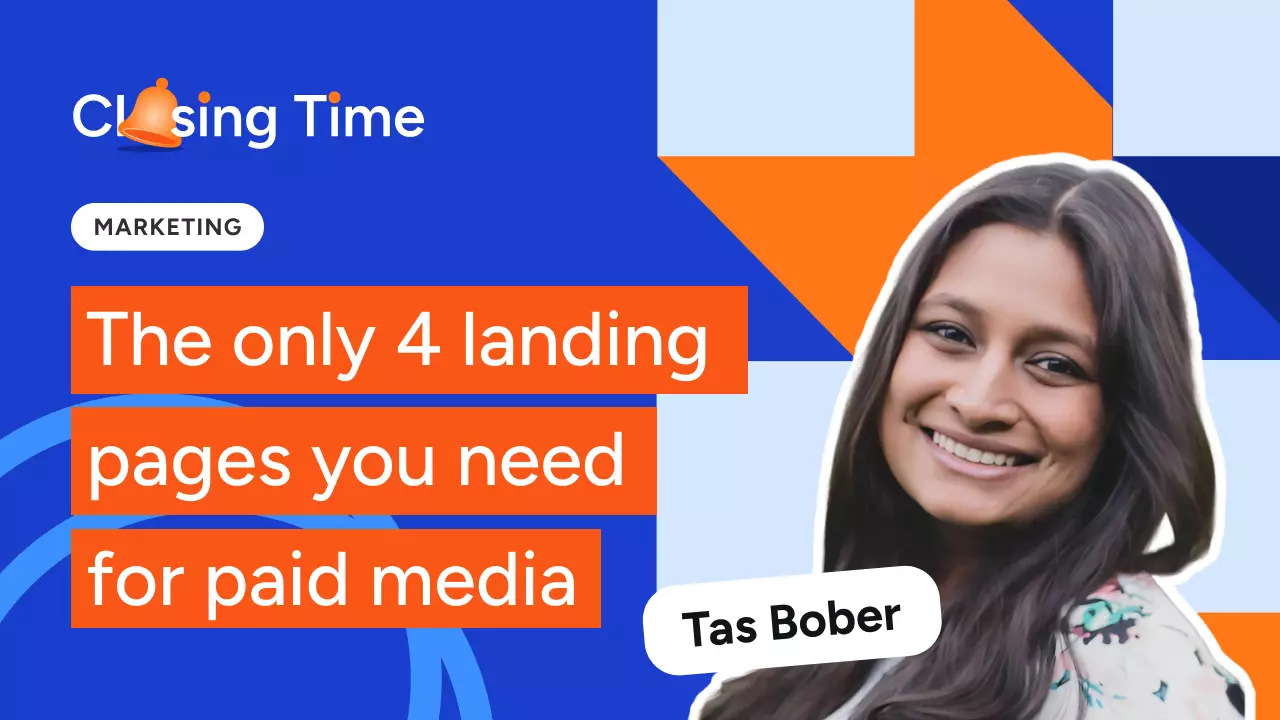
welcome back Tas Bober.
She is the founder of The Scroll Lab.
Welcome back Tas.
I’m so excited
to be back here for round two
so we can get deeper.
By popular demand.
We’re so excited
to talk to you again.
So marketers
that are struggling with paid media,
and I will tell you
CPLs are a little bit out of control
right now, depending on your vertical,
they usually have,
you say 1 or 2 landing page
problems, either too many landing pages
or they’re still sending
traffic to home pages,
which breaks my heart.
Break that down for me.
So I think you’re
making a sacrifice in either regard.
Right?
Where, if you’re sending
traffic to home page and, like, wow,
we’ve put in all this work
on our home page,
we’ve gotten all the stakeholder
buy in.
This has to be approved
and is the page that we can use.
And the page ends up
being this afterthought, right?
We put so much thought into the ads,
the campaigns,
building out the structure,
and then we’re like,
send it to the home page.
It’s probably relevant.
The problem
there, and I always use
Old Navy as an example.
So if you’re
if you’re out of the country
and you’re like, what is Old Navy?
It’s just like a retail store
that I love here.
You go to Old Navy,
you’re looking on Google,
you’re like, I need pants.
You search for pants
and you see an Old Navy ad for pants,
like, great, amazing.
You click on it.
What are you expecting?
You are being expected, right,
to go to the pants
page where then you can
filter and sort.
What if you were taken
and dumped to the homepage?
By the way,
this is actually a very true
Old Navy example.
They love to do this, which is just
dump me on the homepage
and then I have to go find the pants.
It’s like you knew
what I was looking for.
So you have this
message mismatch that’s happening
and now punishable
by Google’s
laws of advertising.
Right.
We covered that in the last podcast.
Go listen to the first episode
we did together.
We covered the relevancy
bit that Google will now
punish you for.
So that’s not going to do anymore.
You can’t be
oh, I’m just going to throw it
to the homepage
and the website
will take care of itself.
Right?
So that’s one side,
which is almost like the lazy,
the lazy hack
Now there’s the other side where
there are the marketers
who are doing too much.
So now there.
And that was me, okay.
Where I was intern,
I’m like every keyword,
every variation.
We got to make sure that it’s relevant.
So we had 60 landing pages
and we had to manage all 60.
We had to build all 60.
Anytime there was a small change,
we to go change all 60.
It was insane.
You don’t need to do that either.
And the problem with that site
is it’s costly, right?
Takes bandwidth
that teams just don’t have anymore.
It takes money.
Again, teams
don’t have as much anymore.
And now with AI,
everyone’s like,
you got to move faster.
You don’t have time to sit there
and make 60 pages
really high quality.
So I found a middle
man compromise,
from both my time in house
and then coming out.
And I was like, oh, you
you can only have a set
number of pages.
Still be relevant,
but still not kill your team
to create.
Yeah.
So let’s find the middle ground between
no landing pages
using that home page,
which is dreadful, we’ve established,
and 60 landing pages where you’re
where you’re overdoing it,
and you’re overburdening either
your team or your agency.
Right.
Okay,
so, these four important landing
page types that every B2B team needs,
let’s talk about them
and what role they play.
And I know you have a good nickname
for them,
so everyone’s
going to walk away from this podcast
and know that number four,
you call them the Core Four.
I call them the Core Four,
And the reason
why I think that’s important
before we jump into them
is before
I came out
and I was doing this strictly
on the marketing side,
and I was in-house head of digital
and website for multiple
B2B companies.
Something I had to do often was
put together a business case
to justify
purchasing
any kind of tool
or partnering
with any type of agency or vendor.
Right.
Because marketing
is under the scrutiny of,
we got to justify every dollar spent.
You know better than me, Val.
Well,
I mean, especially now.
We’re still finishing up
our budget cycle, Tas.
So it’s, you know,
the gray hairs are coming out.
You’re speaking my language.
So go ahead.
And so I knew in order
to get approval from my CMO and my Val,
I had to make a really good case.
And this is true for any champion
that’s internal.
So I had a simple
five page slide deck
that I would use to justify
any kind of purchase I wanted to make,
but to put this five slide
deck together,
you know, how much hunting I had to do
and figuring out I’m like,
why isn’t
everyone just providing
this information?
You have it just provided to me
and make my job easier.
And guess what?
Deals will move faster
because you’ve closed
my research time, right?
So I took that
and put it into the landing pages
and I’m like, what if we were just
honest and upfront
from the beginning?
What would that look like?
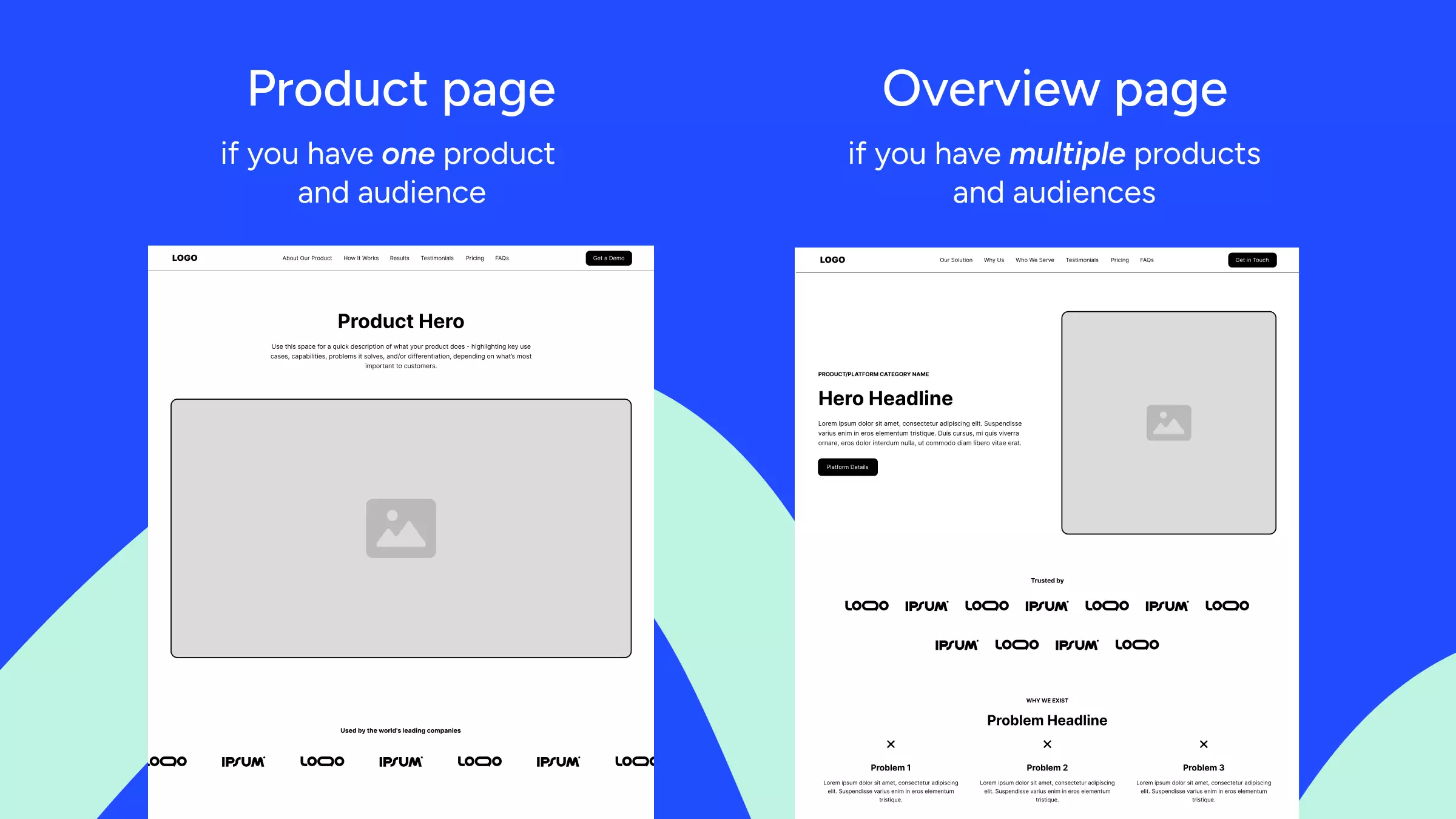
One is an overview page
which is matching my first slide,
which says,
okay, here’s
a capability of us as a company.
Here are the problems
that we exist to solve.
Right.
You have that problem.
We exist
because this problem
exists in the market.
Here are some agnostic insights
into why. Right?
This is the better way.
And here’s how we solve it
as a company, right?
Social proof,
objections, and then the ask.
So let me pause you there.
Because some people might say
that’s your home
page of your website.
But I would digress
and say it is not.
So what are the small differences
between the page you just described
and a home page that,
so we can drive that point home
for folks listening?
Yeah. Great question.
either we call this
like kind of a product overview
if it’s a single
product to an audience.
But if you have multiple products
and multiple personas,
we would call this a primary
overview page.
The reason
why you want to have this page
that is separate from your homepage
is the home
page is kind of like,
a quilt of opinions, right?
So H.R.
wants to put their awards on there,
product wants to put
the latest feature launch.
You,
the CMO, want to own the hero copy.
So what ends up happening
is anyone who works internally
in a B2B company knows
if any marketer attempts
to change the home
page copy
without getting at least
16 approvals
like that, that ain’t happening.
So I always tell marketers
what you can do.
If there’s some of that information
on there, fine.
Clone the homepage, pull it out.
Right.
And then make adjustments from there.
You want a page,
especially for paid programs where you,
the marketer, has
all this control
over the testing elements,
where you can apply conversion rate
best practices
and principles on there,
single CTA,
you remove all the fluff,
get the awards out of there.
You know what is the
the first touch information,
if someone’s never seen you,
interacted with you before,
can they come there
and just get the juice
and essence
of what you do as a company,
what your product does
without the distractions, right.
So it’s kind of a marketers
sandbox where they have
a lot more control.
They don’t have to worry about
the stakeholders opinions
That’s great.
Great differentiation.
Thank you so much.
Because I feel like we field
that question a lot.
And that was a great explanation.
Okay, so the second of the Core Four.
Okay,
so second of the Core Four.
Now, you’re like, okay,
we are so great.
We’re amazing.
But then
the buyer sitting there going,
okay,
but there’s a hundred of you, right?
So this comparison
alternatives page doesn’t
have to be one on one
like our B2B
loves to do the like
feature war
and comparison chart
and like we’re better
than the other guy, that kind of thing.
Yeah. Guilty. Guilty.
Guilty as charged, by the way.
Okay.
But and those pages are great
and they’re valuable,
but it’s good to have one
kind of, umbrella
for comparison page,
because it’s funny,
the data shows
from Harvard Business,
from Gartner’s
research,
they show
that about 60%
of deals are lost
is status quo,
which is the buyer
doing nothing
then to your competitors,
right.
How many times I looked at my own deals
and I was like, oh, we got to wait.
Oh, budget was caught.
Oh, oh, oh,
because it’s hard
to change human behavior.
So you need to do this
comparison of we could stay
the same.
It’s going to take a lot more resources
for not a lot of results.
It’s going to cost us in the long run.
We could do kind of half and half.
Sure.
It’s a Band-Aid fix.
Maybe we’ll see some returns
in a little while.
Eventually that’s going to get costly.
It’s going to be a pain.
Whatever.
We could implement the tool
now, maybe more upfront cost,
but the potential
for a huge increase,
a lot of bandwidth
released with the team
to do all the projects.
That’s how I proposed
a lot of those things, and that’s how
we structure this comparison page.
I do love that.
Because you’re right.
So many deals are lost to status quo.
Because the pain of change
isn’t greater
than the pain of the same.
Right?
So putting that
all on one page
and, giving your buyer
who might be your champion
or your advocate that ammunition
to go to bat for this purchase
just makes so much sense.
Now if you’re thinking, well how
would people would come to this page,
it would be keywords like, best
landing page tools, best landing
page options.
Can I build a landing page
with just my CMS?
So now you’re doing
more of this guide
rather than selling and saying
truthfully, here
are your options on the market.
There’s pros and cons to both.
Here are those pros, here
are those risks.
Here’s what we offer.
If you do want to
you know look at that.
So yeah you can do
some of the selling in the bottom.
But in the beginning
you are kind of guiding them
Are we ready for the third?
Page three.
Hit me with it.
This is my favorite
If someone types
in Unbounce
reviews, Unbounce testimonials,
now they’re kind of bought into you.
They’re like, you know what?
I am going, you know,
Unbounce sounds great.
I just want to see
some proof.
Want to see some references?
I want to see companies similar to me,
people similar to me.
Right.
And they type in that.
What happens typically today
is when you type in company
name reviews,
you go to G2, TrustRadius.
There’s a lot of agnostic sources.
Reddit, and you know
Reddit is not nice half the time.
So no.
So it’s so funny to me
that companies
are not controlling the narrative
when it comes to this
almost like
mid to bottom funnel
experience, right?
what we end up doing
is creating a landing page
that is kind of a
voice of the customer page.
So we will bundle that
with a bunch of proof.
Now they show
I’ve seen
users will not really
read a long case study.
So how do you
make those work for you?
You can break a case study
down into three different parts.
You can use it to tell
a specific use case story.
You can pull out just the quotes.
You can pull out
specific examples of a problem
and then the solution and do a summary.
Some of the quick wins
that you saw from that.
We put light testimonials,
which are shorter,
shorter ones that you can put
at the beginning of the page,
the logos, things like that.
And we bombard this page
with everybody
saying stuff about us
except us.
It’s so powerful.
Thinking about my own journey
as a buyer.
If I can find that type of page
and I can see someone with a job title
similar to mine,
that’s a win.
Because I feel like I’m
actually asking a friend.
Right?
Or someone who understands
my needs as the,
you know,
based on the position that I’m in.
Okay.
The fourth of the
Core Four let’s get to it.
This is the one then
we go from the least popular
to the most popular.
Everyone loves this page.
When someone thinks of a landing page,
this is the immediate page
they think of,
which is the demo
or a signup page, right?
Immediately every landing page,
if you close your eyes
and you picture a landing page,
it’s that, the form is top left.
I can picture it some copy
on the right hand side,
some nonsense below
and like sign up, right
button colors.
We’re testing it.
So this is the most common page.
And it’s funny because
marketers will create
60 of these
with just a slight
keyword variation
when they realize,
that in fact,
it is the opposite.
What they’re doing,
they’re asking for a transaction
probably too early in
the journey, right?
If it’s someone who’s a first touch
points like,
why are you asking
for my information already?
And therefore
we have the four pages
that kind of take them on a journey
from first touchpoint.
What are the other
alternatives in the market?
Okay, well,
I’m kind of bought in now.
What am my peers saying?
Okay, I’m ready to take the
next step, whatever that is.
Tas, I
love the Core Four,
what do you say
if a marketing team says to you
we just don’t have the bandwidth,
that’s too much of a lift.
The nice part
about building these pages,
especially for paid,
is that you can do it
component based
so you don’t have to sit there
and create every page from scratch.
Right?
You have the problems
that you saw for your customers.
You can use that same problem block
across all the pages.
You have your value proposition
where you’re highlighting
your differentiation, right.
That’s your solution.
Block.
You can repurpose that across
multiple pages.
You’re laying the expectations
of what the sales process is like.
That block again
across all the landing pages.
So you don’t have to do a lot.
You just have to kind of change
up the top of the dish.
So I always look at it
as like, Chipotle like a reference.
Right.
And so you have all the ingredients
already.
You’ve done
the work and collected the ingredients,
but are you packaging it up
like a burrito,
a taco salad,
whatever the packaging is.
Right.
You’re going to highlight that first.
So Trust Page will have like
you know, 2000 customers
trust Unbounce..
That’s going to be your hero.
But if you are a
first touch person,
you’re coming to the product overview.
It’s like Unbounce, the landing page
tool, number one
landing page
two on the market, whatever.
So you’re going to kind of
do more of an introduction,
but it’s the same story
just told in different ways
based on what
users are asking
for or looking for.
Got it.
Okay, so we had the Old Navy example.
We had the Chipotle example.
Our audience is all set.
Tas, where can folks go
if they want to hear more from
you on landing pages,
B2B landing pages, your specialty.
Yes.
Find me on LinkedIn.
That’s the best spot.
Tas Bober.
Tas and then last name Bober.
I also have a landing page
resource hub, which,
now Unbounce
has partnered with me on.
We’re also doing
a landing page swipe file,
so you will have examples
of all of these pages
that will be able to launch together.
Come there.
We post ton of content,
and we’re also going
to release templates for each of these
in the upcoming months together.
And it will be available
in the Unbounce library as well.
So, get the education
and then go forth and conquer
without having to spend a ton of money
and without,
having to exhaust your resources.
Great.
So if you heard it right,
Tas and Unbounce
are joining together
to help make those Core Four
even more possible for you.
So be looking for that,
in the coming weeks.
Tas, thank you so much.
You are the Queen,
I was gonna say you’re
the queen of B2B landing pages.
I think you might be the boss
because you’re giving me boss energy.
Oh yes, I
love boss way better.
Okay, great.
And thanks to all of you
for tuning in to Closing Time.
Remember, you can get this episode
and all episodes delivered
right to your inbox.
Just click the link
in the show notes and we’ll see
you next week.