




If you’re a founder, sales isn’t optional.
Today we’re talking about founder led sales and how to scale it without breaking your business.
Join us on this episode of Closing Time.
Thanks for tuning in to Closing Time, the show for. Go to Market Leaders.
I’m Val Riley, head of marketing for Unbounce and Insightly.
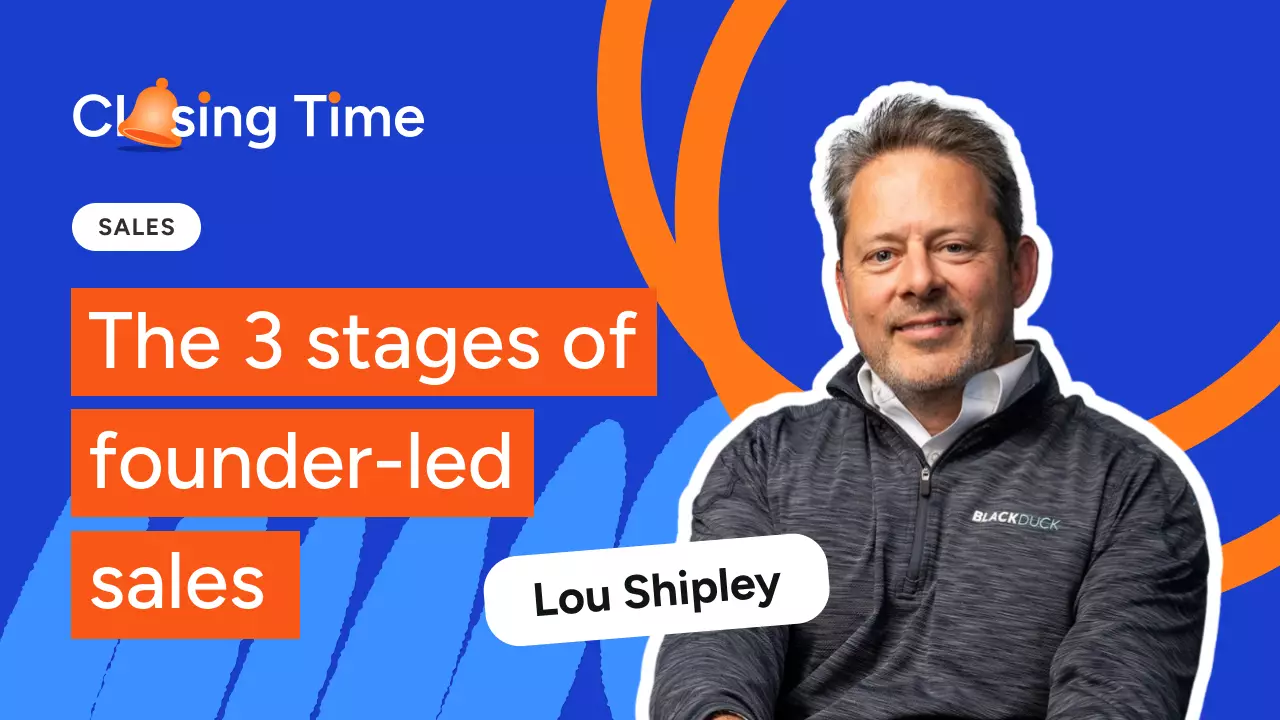
Today I’m joined by Lou Shipley.
He is the author of the newly released book. Unlikely Entrepreneurs.
Candidly, we get a lot of pitches for people to appear on Closing Time,
but this topic really resonated with us and we reached out and asked Lou to come on the show.
Lou, welcome.
Thank you very much, Val.
Pleasure to be here.
So one of the things you mentioned in our pre call, Lou, was that the name of
our podcast has some special meaning for you.
Closing time.
That’s a song, that we used to play.
My last company, Black Duck software, when anybody would
close a deal, we’d play the play the song on the sales floor.
And, especially towards the end of the quarter.
So, it, and people had to sing it, and we had a lot of fun with it, so.
Yeah.
No, it’s, there’s some real, real meaning for me.
Yeah. You know, it’s a catchy tune.
Everytime I
hear it out and about now it just brings me right back to this podcast.
So, glad it made a good memory for you.
Yeah.
Yeah, absolutely.
So you’ve clearly been in the trenches with founder led sales.
Every startup that I have been a part of,. I would say the first
and often best salesperson in the whole company is always the founder.
Do you think it’s because that person truly believes in the company?
Yeah.
I mean, it’s a really interesting question because I work with a lot of founders.
I’ve been in, you know, many, many startups and, boards of startups, advisors, investors into the startups.
And the common thing that I see is
some founders are natural salespeople and sort of take to it.
But for those that aren’t, there, they have to go through this period of understanding
what sales is and overcoming misperceptions of
why sales in our culture is maligned and misunderstood.
And, and that’s partly what we teach at
in our Harvard Business School, classes on sales.
So you have to overcome your fear and disdain of sales.
And once you understand really what sales is and what sales excellence is, then the founders are just that’s
what they want to do all the time, because they’re they really are the best people to sell, sell their company.
Not just customers, but investors, employees, etc..
So that’s what you consider like stage one when it’s the founder salesman who is really out there,
personally landing those first early customers.
What does that stage one feel like for the founder?
Yeah.
by definition, you found a company, you created something from nothing.
So you see something that needs to be in the market.
But your customers, some may see it, most don’t.
Most are pretty aware that there’s even a need or a solution to the product.
So the trust that’s required for a founder to
to land their first customers is immense.
So you have to develop a trusting relationship with someone
who’s going to bet their career on you and your company.
So learning how to build that trust
is really the sales process for those those original founders.
And we recommend, that the founder closes
the first 15 to 20 customers before they hire a salesperson, because then they’ll
they may not be the best salesperson, but they, they understand the sales process.
So they started to started understanding the sales process.
And then then you can bring in a sales leader or a salesperson,
but you can’t delegate it before you understand it yourself.
That’s that’s where failure comes in.
Let’s talk about that next stage where you’re either bringing a
co sales leader in your first salesperson or your first maybe sales manager.
Where when founders hire
sales leadership, what sort of pitfalls do they need to avoid.
And, and how do they have to evolve to support that person?
Well, Val, thanks for asking that question because, my answer comes out of failure myself.
So I’ve failed in this one.
So the most the most common mistake is,
bring in somebody you’ve worked with before or somebody who’s been there, done that.
And, has a track record for success in whatever you’re marketing as well.
And that seems sort of logical and obvious, but what it what if you do that
and you delegate too much of the creation of the sales culture,
then you’re at risk of having somebody bring in
both their sales process methodology and compensation plans.
That worked in another company but may not work for yours.
Yours has to be designed around what your buyer’s journey is,
how your customer for your specific product wants to buy.
So so that that’s why the selection of the first salesperson or the first sales
leader is so critical, is that they need to understand what’s unique about your situation
and adopt what worked for them in previous companies to your situation.
And too often I’ve just seen people come in and I’ve made this mistake myself.
Bring a comp plan from a previous company, hire people that were really good at one industry into another,
and it it often fails, most likely will fail.
Or the worst, it’s your brother-in-law.
Let’s like let’s not go there.
Right.
Yeah, I’ve seen a bunch of that stuff right.
Yeah. So, we’ll shift to stage three.
In stage three, you’ve got
obviously you’ve have enough momentum where you might need to bring in a chief sales officer.
So, your founder, as a founder, you’re stepping back, really
from the day to day operations of sales at that point.
But, you know, you still own revenue as the, as the CEO and founder.
what does that stage look like?
And how do you find that person?
what it takes to be a great founder is really different than what it takes to be a great CEO.
And there are some people that are able to bridge that and and be great at both.
I’ll give you a three examples.
Someone named Kevin Frechette co-founder and CEO of Fairmarkit,
Zach Maurides, founder of Teamworks and great CEO, David Friend,
co-founder of wasabi and CEO of wasabi.
But more often than not, somebody is good at one or the other.
In fact, in my case,. I was actually really better as a CEO than as a founder.
And so the what it takes to be a really successful CEO at this stage,
the stage you’re asking about now is to realize that it’s you can’t be in the middle of everything.
You have to hire strong people and delegate and run interference at a very higher level
while still being able to go in and, you know,
work with customers and do tactical activities.
But you can’t be in the middle of everything.
And the mistake I see founders making at this stage is they still want to be
at the center of the universe, and it won’t work, because as you’re scaling,
you can’t scale fast if everything has to go through a certain person.
And, in our book, Unlikely Entrepreneurs, we talk a little bit about this
notion of distributed leadership and what it takes to create leadership
so that your team can execute quickly and be agile while you’re not in the middle of every decision.
that’s really the the shift then when you’re no longer
maybe you’re pulled into some of the big deals or the super pivotal deals but the day-to-day
operations of the sales team
is really handled and and completely managed, separate from the CEO,
or founder, that that just must be a hard adjustment for that person to make.
It’s a hard adjustment, and not everybody makes it.
I mean, you do see, like, some famous tech, CEOs like John Chambers
when he was CEO of Cisco, or even Marc Benioff, now. Salesforce, they still come in and work on the big deals,
like when there’s a monster deal and they’re up against their arch competitors,
they’ll come in and they still are on the hook and they still are responsible.
And by the way, the customers want to know the CEO if they’re making
a huge commitment to your company because inevitably something will go wrong.
Like, I was a CEO for 13 years, something was always going wrong
with your customers, and they want to know that, that the company
can get to the most senior level to allocate the resources to fix it promptly.
If they don’t have that CEO relationship, they might go with someone else
because your competitor, might have a CEO that really likes sales.
So that’s why you really have to still embrace it when you’re in a very large company.
of course, at this stage if you have a chief sales officer you’re likely
now have a rev ops or sales ops team.
You’ve got enablement people on staff.
So the job really just becomes a lot bigger.. It does. Yes.
You know, you’re right.
Now you’re talking about a sophisticated, process oriented sales organization
with systems and training, and, you’re basically trying
to create a sort of a math equation for how you build, forecasting
for sales, whereas in the founder stage or in the early stage, it’s
it’s sort of the dive and catch, there’s a hero, the product doesn’t really work.
You’re trying to convince people that this latter stage, it’s about it’s about data and about RevOps as you say,
and sales enablement to build this sort of math equation so you can build forecast predictability in the company
because as you get to this point, when you want to maybe be public, you have to hit your numbers.
You can’t miss.
And so you have to know those numbers down like it’s a math equation.
One thing that you have done in your career, which I find fascinating, is that you are developing
sales curricula for Harvard Business School, and I’ve been
in SaaS marketing for 25 years.
And it’s amazing to me that for so long
we have not had sales as an education path in our schools.
Like, you could major in marketing, you could major in business, but professional selling
was not something that you would see on, a college, you know, list of courses.
And you’re working on changing that.
Yeah.
No, there there’s a number of reasons for it, Val.
The first one is, you know, business schools, especially traditional business schools,
sort of thought of sales as like a trade skill.
Like it’s not really something that you go to business school for, there
you’re going to learn marketing and strategy and finance and that kind of thing, how to work a balance sheet.
And but the reality is
everybody has a top line like you and I have top lines.
It’s called our salary.
You know, governments have top lines.
It’s it’s the income they raise from taxes.
Companies have top line.
So the top line is so important.
Why don’t you teach it now?. I think it’s for a couple of reasons.
One is people have this negative perception of what a salesperson
isn’t, that they get that from whatever their personal experience is.
By the way, if you ever seen the sign No soliciting, it’s a sign that’s basically made for the function itself.
Like, please don’t do this.
You’ve never seen one called, no marketing or no finance or no strategy, those things are okay, but not sales.
But the reality is if you’re going to start a company, it’s the first thing you need to learn to do.
So it’s been very interesting.
And enjoyable about both teaching at MIT and Harvard.
Is that students are very entrepreneurial now.
They want to start their own businesses and they realize, I got to learn this.
I got to overcome my fear of this.
And that’s why the classes are very popular, because they realized, hey,
all right, I’m going to learn how to do this skill and we make it a lot of fun.
We have a lot of fun teaching the class, but it’s been very, it’s been very enjoyable to see.
I started ten years ago at Harvard, about 40 students.
This year we’ll have about 500 in the same class size, just that people are opting into it.
Yeah.
I, on a personal note, my son’s a university student, and he has, interest in sales,
and he’s looking at a professional selling minor, which I was delighted to see was an option.
So, Yeah, I think it’s an attractive path for a lot of students out there.
What?
What are you teaching in those classes that might surprise people?
Yeah.. So we have essentially four different sales classes.
So we break it up into kind of like this discussion we’ve been having today.
There’s a class on founder selling that’s developing an understanding of the skill of selling.
And in that class a student is assigned a sales coach.
And we record role plays on Gong..
And then the sales coach reviews it with the students.
So after the semester, they feel like, all right, I know how to do this.
We teach all the different sales methodology.
So that’s the first one, which is you know, what’s the skill.
So what is selling personal selling as a founder?
The next one is all right.
You’ve gotten to say 1 million or 2 million in sales.
How do you get to 100 million or 500 million?
That’s all your first as a sales manager, your first forecast, your first board member review,
your first compensation plan, all those first, your, first channel, that sort of thing.
And then and then there’s another class that,
is for really large sales organizations.
Like if you’re going to go work at IBM or Salesforce, we have those companies come into our class
and talk about, all right, you have 10,000 salespeople, 1100 comp plans.
How do you manage this?
It’s a big management challenge.
So those are sort of the three big ones.
And there’s one other one that I created specifically for founders who have an idea for a business.
And what I saw over the years was students would come up with an idea,
build a minimum viable product, raise venture capital, and then try and figure out how to sell it.
And I saw a lot of failures with that model.
So I said, why don’t we figure out if your idea is salable and let’s build a sales playbook
before you actually build it MVP and before you get it financed.
Because just because you have your company financed doesn’t mean you have a right to exist.
You have to get customers to have a right to exist.
So that class is called the Sales playbook class.
The output of it is your sales playbook.
If I do start this company, here’s how you sell it.
Here’s what of the playbook I would give to my first sales rep when I hire that person.
Right.
I mean, there’s no better way
to make sure you have product market fit than to actually go out and try to sell your idea.
So I think that’s super Exactly.
So it sounds a little bit like,. I know you just recently released a book,
Unlikely Entrepreneurs, Yeah,
yeah.
Here it is.
Who is the book for and what do readers walk away with?
Well, I wrote the book with, my coauthor,
Patricia Favreau, who I met when I was working at MIT,
and the idea was to tell stories of,
entrepreneurs that not are not necessarily. Silicon Valley AI billionaires.
It’s not that I have no problem with them, I think is, but this is more about the person around the corner.
Your neighbor who has either an idea for a business and telling their story about, I have an idea for a business.
How do I get my first customer? How do I finance it?
How do I market it?
So it’s really for aspiring entrepreneurs
that are thinking about a business that may not have the confidence to do it.
And we profiled 17 different, entrepreneurs and tell their stories.
Now we also talk about failures, right?
Because entrepreneurship is about failure.
I’ve been involved with companies that have been shut down because for a variety of reasons.
So we it’s not just about the wins and the 17 people that have done really well, there are losses there.
So it’s sort of an honest, reckoning.
But we hope it’s inspiring for people to think about.
I got this idea,
maybe I can do it.
And so we, even some of the people we profile very inspirational.
Yeah, I feel like you’re saving.
There’s a lot of trial and error out there with entrepreneurship, so maybe reading this book
maybe saves people 1 or 2 of those mistakes, right?
Yeah. No, absolutely.
If nothing else, it’s a fun, entertaining read.
We have people that started, breweries, you know,
a woman who has a sustainable sausage brand, a person that sells caskets online.
So these are not just.
I mean, yeah, there’s some tech companies in there, too, but these are really unusual business.
And unlikely businesses.
And that’s why it’s kind of fun and entertaining.
Lou, this was great.
Thank you so much.
Without sounding too cheesy, it’s closing time for this episode.
Okay.
Thank you so much, Val, I’ve really enjoyed, being on your show and congrats on all your success.
Thank you so much.
And thanks to all of you for tuning in to Closing Time.
Remember, you can get this episode in every episode delivered right to your inbox.
If you click that link in the show notes and we will see you next
time.