




AI is rapidly changing how sales teams operate,
but what actually happens when you replace parts of your sales team with AI?
Let’s dig in to that topic on today’s episode of Closing Time.
Welcome to Closing Time, the show for go to market Leaders.
I’m Val Riley, head of marketing for Insightly and Unbounce.
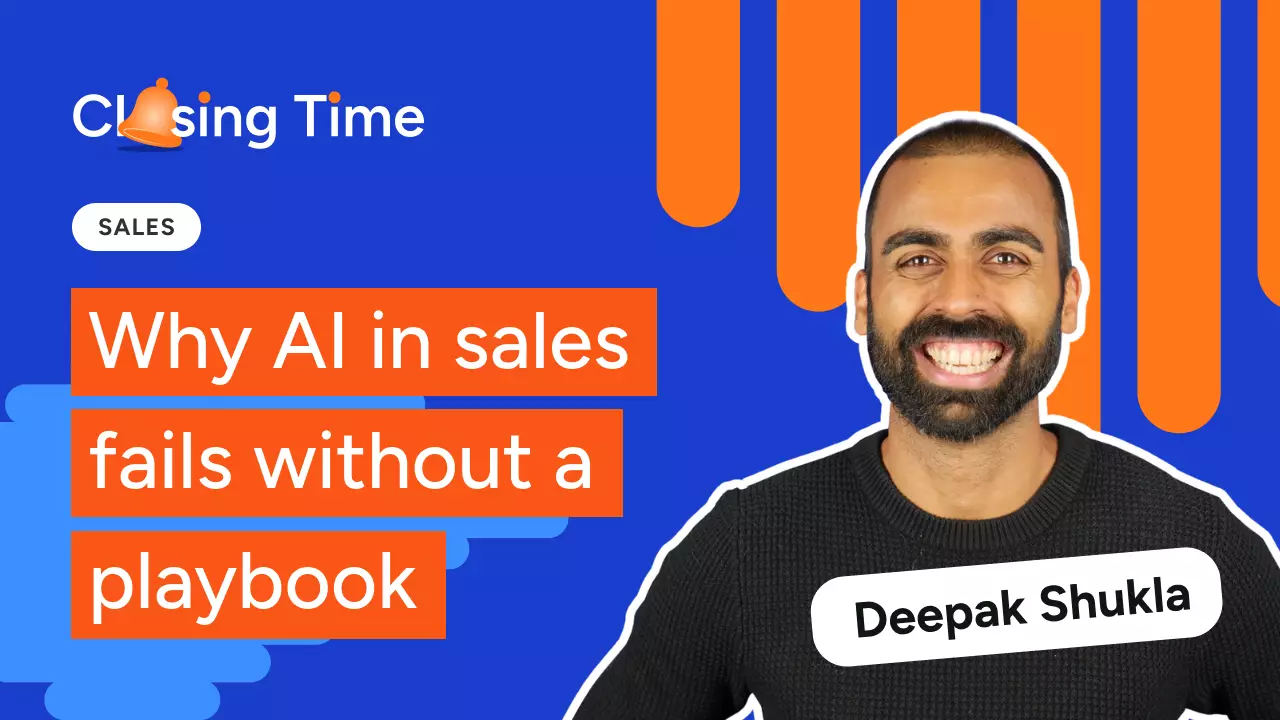
Today I am joined by Deepak Shukla.
He is an entrepreneur and AI strategist who has been helping companies
rethink their sales workflows and operate with AI.
Deepak, welcome to the show.
Hey, Val. Really happy to be here.
Excited to talk about AI.
And thank you for the introduction.
All right, well, let’s get started.
And I want to start with inbound sales because that’s where most companies
are experimenting with AI.
First, you’ve said that before companies can really deploy AI agents for inbound,
they need to build an operating playbook, essentially documenting
their processes and use cases, so AI has something to go on.
What does that playbook look like and why is it so important
when you’re introducing AI to have one?
Sure.
So I think the people here playbook, first of all, and their mind melts
a little bit because they think, okay,. I’ve already got a playbook.
My guys have got the pricing, they’ve got the framework and the layout.
But in practice, what tends to happen is there are almost an infinite
amount of edge cases, more especially so with service based businesses.
But I’ve also seen it true with SaaS.
So as much as anything is productized where it actually is, let’s call
it software as a service or a physical service or digital service.
There’s always edges.
I mean, I’ve renegotiated contracts with zoom info with HubSpot
and many, many other companies,
and I’m sure there’s a lot of people out there doing the same.
So what happens then in practice is that people implement AI too soon
because you’ve not thought about all of the different types of scenarios
that come up.
So how do you, for example, adjust
dollar pricing when you’re talking to a Canadian
versus talking to an American because of a currency conversion?
Everyone’s still talking in dollars, but the value is totally different.
So what tends to happen,
and what happened in our case, was that we launched AI too quickly.
And it was just annoying people, frankly, because it couldn’t understand
things like this that became really important.
So when we talk about playbook, it’s about understanding all of the nuances
that exist across the business.
And you’ll often find that you’ve got mental models,
but you need to build them into actually documented models to then really
use AI in the most effective way.
Yeah,
I sometimes it feels like the exception is the rule, right?
Because, when you’re trying to negotiate, you’re definitely willing
to make adjustments or changes
that don’t follow, like the exact pricing that maybe is on your website.
Just to make a deal go through.
So it’s all of those edge cases that really cause AI to stutter a little bit.
Yeah, yeah.
For us, it’s been like that, you know, an example that we had recently, a startup
that’s funded with personal money
verses a startup that’s funded with an entrepreneur
whose got exit money verses a startup that’s
funded with government money.
Even that word is so nuanced.
And you apply different filtering based on each of those scenarios,
and therefore it’s painful.
But you really need to think about building that playbook to incorporate
all of that.
Otherwise, you have what you see there’s popularized now,
all of the big corporate companies having what you call failed
AI implementations because actually in the end they pull it
right back because I think
that even at my level, I’ve seen that, wow, there’s innumerable variations.
So yeah. No, I couldn’t agree more.
The playbook it’s a bit of a cliche term, but it exists for a reason.
All right.
So let’s say you’ve convinced, folks hey, get that playbook documented.
Get all those edge cases in there.
So now we’re going to start applying. AI to inbound leads.
In a traditional sales model, like a human person qualifies
leads, decides whether to book an appointment or not.
AI can handle that step.
How do you see AI qualifying inbound leads and booking meetings,
even before a salesperson is even aware of the prospect?
sure.
So I think that in an ideal world, first of all,
you think about it from a sales person’s perspective.
Every sales person wants a sales qualified lead
who’s got decision making authority to come to a call.
Anything less than that is not ideal.
So when you think about it through that framework,
what are all of the things
that we typically ask people to quantify over mechanisms prior to calls,
which is typically, for example, email, chats, WhatsApp, telegram and the like?
So when you look
at all of these platforms, first of all, a lot of them have API access
that allow you, of course, to then pass through messages.
Second of all, we even mentally and again, it almost dates back to the playbook
we have mental models for, let’s call them keywords that we look for.
You know pre AI we were kind of doing say to AI would what we call
deterministic logic which is ultimately if this then that scenarios
and formulas that we were building.
So it’s really making sure that you’ve got that
put together in a framework and what you’ll actually find,
and this is the interesting part that AI then becomes
the sliver for managing edge cases.
But if you built a really strong rulebook, deterministic logic can carry you
a lot of the way.
And fundamentally that is a case of giving AI rules.
So then what happened with us
practically is we began with human based rules in a document.
We then fed it to a GPT.
The GPT was then still being used by a human.
The GPT was making errors based on cases that were coming up.
After three months of edge case handling,
we began to get to a place where, okay, maybe we can let the
rat out of the
mousetrap, or let the mouse out of the mousetrap
and see kind of what happens out in the wild.
Again, then came up more problems.
But then eventually we got to a place where, hey,
80% of emails now can actually be handled.
We’re still learning
because there’s still some edge cases that come up once every so and so.
Broadly, however, I really do believe that if you’ve got a mature lead flow,
it does take that amount of time to actually build it out.
And even when you only think, right,. I can have I start from day one,
you’ve still got all of those edge cases to come, so you’re still going to have to
learn things down the line as you develop, ultimately, your sales process and flow.
So email. I think, is a great place to start.
However, it does begin with that framework human first,
then rule book, then rule book into a GPT, then GPT with human.
GPT and human analyzes GPT.
More edge cases built.
Then we try and pull out the human, but then we still really monitor
and do check ins.
More edge cases occur because also it’s a consequence of how
well are you building the rule book and how much is it subject to interpretation.
So this is the framework that we followed.
Where now, if you were to come into our organization, we’d say, look,
we’ve improved the quality of leads coming to your calendar
by probably 40, 45% through using AI and deterministic logic.
And now a human steps in intermittently.
But whereas before it was 20/47, now it’s probably, you know, 4/7.
So four hours a day, seven days a week to just monitor.
And that’s kind of the process we follow now.
Gosh,
I almost wish there was a magic, you know, wand where we could
everybody could transform themselves and get past all of that, that hard stuff.
Right?
The the human, the human plus AI time frame.
Because I imagine the first time a rep gets a qualified, appointment
on the calendar and it works flawlessly, it must feel like a million bucks.
yeah.
No I exactly it’s a wonderful feeling.
And the challenge I think that we have,. I have as a you know, we’re at what maybe
I think about 134 people eight figure business.
We are still small by many means.
And the upside slash downside is that you can be agile, but it also leads to
impatience and this is a place where there is a need for proper process.
And what happens is you’re like, right,. I can install the API or the integration.
I’ve got my key, I can let it run and you quickly discover that,
oh wow, it’s causing more bad than good in the end.
So it yeah, we’ve had to go through the learning
curve, and that’s inside out what our learning curve has looked like.
Okay.
So what we’ve described now to me is like the Holy grail,
like that’s where we all want to be.
But in practicality today, most organizations aren’t there.
Right.
But they are having sales reps do things like use AI to draft email replies.
Maybe generate proposals, maybe schedule meetings, or prepare for sales calls.
Are those use cases actually delivering value right now?
And is that a way, like almost a stepping stone to get folks
to invest in that next level that we were just talking about?
I think that there’s definitely
a framework for adding
AI assisted intervention across
the spectrum.
Again, however, annoyingly
it is a matter of how intelligent you can prompt engineer
because two people can say great I did, so I’ll give you a practical example
of what this looks I observed,
language is a funny thing.
I have two sales reps that will both say that they’ve done sales prep,
and they’ll produce completely different
materials, across the spectrum in terms of what
they have that’s useful for the call, because you can ask a LLM
to prepare you for a call, but it’s still relative to how the
LMM is primed and what’s also important to the company in terms of outcome.
So that might mean, hey, if I’m preparing for a call,
I want to also have the rep know about what’s happening in their industry
and not just about that service.
So you can sound like an insider, and I want you to be able to use
industry jargon.
So if you’re talking to a Chief Revenue. Officer, if you’re not using ABM,
SQL, MQl, AOF, LTV, and you’re going to talk about.
So then we close business and then we get the next deal.
There’s a real distinguishing bit of quality.
So again who’s prompting.
And therefore what is the output.
So all of that is possible. The
truth is, is that it’s the whole kind of monkey with the machine gun
scenario that you need to still,. I think design frameworks to ensure
that there’s a kind of a ringer that every prompt is going through
to ensure that there’s kind of consistency and output,
if that’s what you’re looking for,
like a bit of a standardized knowledgebase, a dossier, if you will.
So that meant that with the GPT that we ultimately built for sales
reps to use, we had to put really strict guardrails built in.
And now what happens in our team is, if you, for example, have a booking
that comes into your calendar, then we’ll run that through a knowledge
base that has strict instructions as to what it should produce.
So in that scenario works really well.
I have I know still the reps do use it, but the problem also with different
reps using AI, is it again that problem of producing wildly different results.
Some people get lazy
and you can tell they got the double dash, which is quite classic within AI.
But not everyone apparently is aware of that
because I still see it in emails coming up.
And then also there’s just funny, like that’s because people get lazy.
They just say, improve this.
there’s no avoiding the hard work.
So it’s again
that 20% of people will produce,. I think quote unquote exponential results.
And then everyone else, you’ll just be able to tell from looking at it,
Val didn’t write this email, Val’s. GPT wrote this email
and that’s again another challenge that we have.
And that’s why we had to create. GPTs strict rules around
how people use these LLMs.
Because when people deviate from it, they produce all kinds of wild stuff
in the emails that I’ve seen.
Yeah I mean it sounds like most other things right.
It’s like you get out of it what you put into it you know.
I mean we sell CRM and you have people who have wildly successful CRM
implementations and you have people who have really poor CRM implementations.
And the idea is how much time did you put in upfront to make it work?
So sort of the same message overall.
I’m going to ask you to pull out your crystal ball.
Because we’ve talked a lot about inbound sales, but not so much about outbound.
Do you foresee a future where AI could really do a good job with outbound?
Because most of what I have seen is not been great so far.
I think, yes, I think that again, it’s about understanding the constraints
and how to make best use of what exists.
So if we talk more tactically now because my, my underlying theme
is that everything’s tough,
which isn’t always ideal for someone who’s like, Deepak, what’s the hack?
I would say that when you have a novel offer, then AI can work really well.
So for example, if I say, hey, we’re giving away a free gift
card to this software, it’s free for one year.
That’s it. That’s the offer.
What’s the catch?. There’s no catch. Try it.
And if you like it after the one year, subscribe.
That’s a novel enough offer that you don’t
really care about the quality of the salesperson who’s pitching that,
because the quality of the offer is strong enough of itself to convey the message.
So in those types of environments where you have a truly
have a unique offer, a unique mechanism, something that and the this is the
kicker.
Most companies don’t. Most companies just don’t.
If you’re in, I’m in digital, almost everything is commoditized
unless you can figure out the Alex Hormozi he talks about $100 million offers,
Russell Brunson talked about it before him with Clickfunnels and all of his books.
And before him there were others.
You need to if you have a unique mechanism,
then I do believe that. AI outbound can work
because it’s just about the quality of what you’re offering.
Then even if it’s fumbled
and it sounds a bit robotic, you don’t care, you don’t care.
Like in the same way that I make lesser distinctions with people that have broken
English, struggle to get through a pitch, but they’re selling me, for example,
a software product.
If the quality
of the features and benefits are important to me, I make more of a decision on that
if there’s a need there, as opposed to how well they conveyed the pitch.
And that gets more complex as you go down the hierarchy with services.
So yeah, when there’s productize offers or something
that’s novel,. I do think AI outbound can work. Okay.
Well that’s exciting.
Maybe that’s the first step.
Is those novel offers that are really sell themselves.
Okay. Last question.
You’re talking to a sales leader and they are curious.
They’re not doing anything AI related.
What would be the first step?
You would say, hey, it’s okay.
You’re not that far behind.
Here’s something you could implement pretty easily.
Sure.
So I think the first thing would be,. I mean, I’ll go through a couple of things
because it’ll be different for different people.
But number one would be, hey, pay for ChatGPT or pay for Claude number one.
Number two would be hey, if you pay for it, then also start using projects
and also within ChatGPT as an example, because people tend to skew one way.
I use ChatGPT for everything at the end,. I tried other LLMs,
but my your brain doesn’t work that way.
But all of them broadly offer a similar kind of suite.
You have your paid subscription, then you have GPTs.
I’m not sure if Claude can do that.. Probably it can.
Then you have projects
and I think getting familiar with the house
in which many future businesses will live in is a first thing.
So I think the the biggest thing for business owners is to be,
especially if you’re small and agile, is you have to be familiar
with what you’re doing to, to to make best use of it.
And then I think from there you’ll begin to kind of extrapolate out
what’s possible.. I think. And I tried that.
What I did try is have other people deploy it.
And then there was incorrect deployment because they didn’t have enough
of an understanding of the business and the nuances.
So also,
if you’re the business owner and you’re not going to be
the person doing it yourself, give it to someone who’s tenured
within the business, who understands how the business works.
Because the problem with people that are avant garde
AI is that they still need to learn the nuances
of how your business works internally, which is problematic within itself.
So you need to find where the rubber hits the road
and find someone
who understands the business well enough, but is open enough
to really embrace what’s new and get through the learning curve.
And that’s kind of the sweet spot.
And ironically, in smaller companies, that actually tends to be the founder
and founders will often defer the burn your brain calories part to someone else.
And when it’s something that leads to category changes,
I think that that’s not it’s not sensible
with AI, it’s a paradigm shift.
So I think that’s where owners should come in and put in the hard yards,
because it can lead to massive change, it’s transformational.
So I think that that’s where I would start.
If you have yet to embrace it.
I don’t think anyone would argue.
It is definitely transformational.
I also want to do a quick plug.
If your sales team and your marketing team can be on the same
AI LLM that’s a plus.
So, that’s my little plug from the marketing chair.
Yeah. Deepak, this has been fascinating.
Thank you so much.
I think a lot of companies
are asking these questions right now, and I think
the timing of this episode is perfect.. So I appreciate your time.
Oh no, thank you for the chat,. I really enjoyed it.
And thanks to all of you for joining us as well.
Remember, you can get this episode
and every episode of Closing Time delivered right to your inbox.
Just click the link in the show notes. We’ll see you next time.