




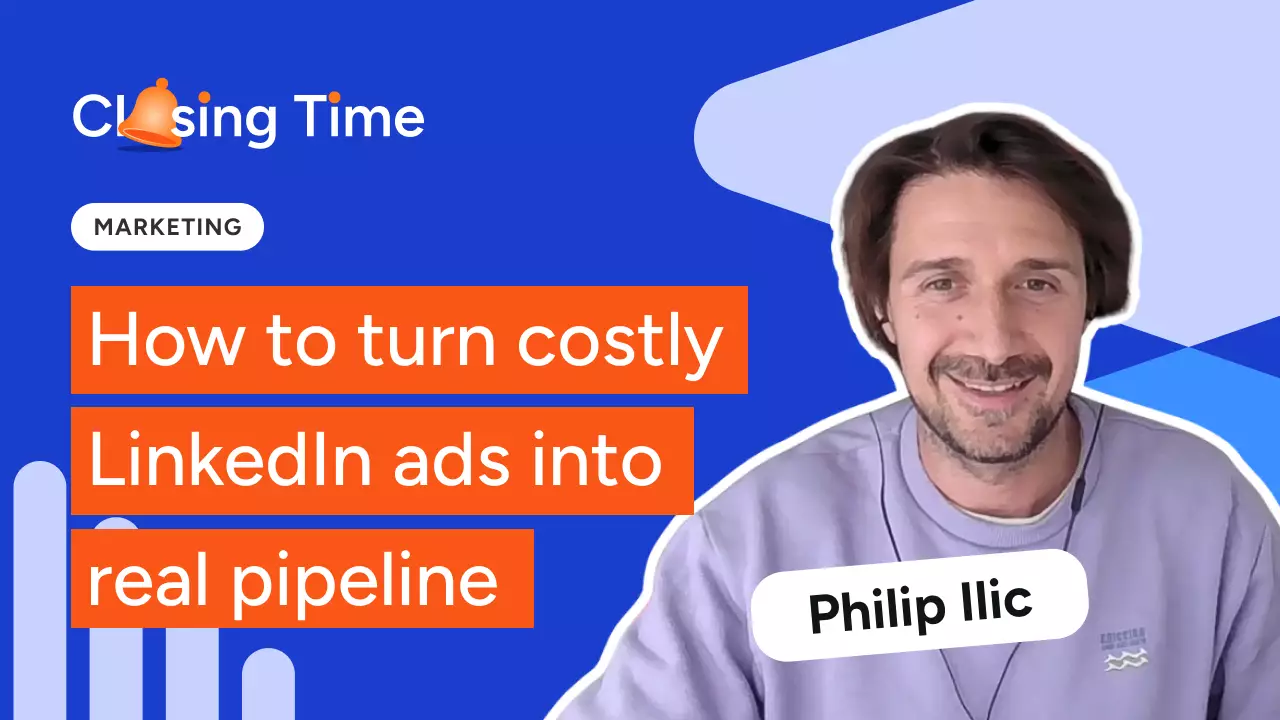
LinkedIn leads are some of
the most expensive in B2B marketing, but are they actually worth the cost?
Let’s break it down in today’s episode of Closing Time.
Thanks for tuning in to Closing Time, the show for go to Market Leaders.
I’m Val Riley, head of marketing for Unbounce at Insightly.
Today I’m joined by Philip Ilic,. He is a B2B growth expert who specializes
in LinkedIn strategy and helping customers drive real pipeline, not just leads.
Welcome to the show, Philip.
Thanks so much, Val, really excited to get going today.
So thank you for having me.
So let’s dig in.
This is a topic that’s on the mind of marketers
all the time CPL and general, but specifically for LinkedIn.
So let’s start with the big question.
LinkedIn leads are expensive.
When marketers say that they’re too costly.
What should they actually be comparing it to?
Yeah, exactly.
I mean, there is a few different things we can talk about here but CPL on
a kind of metric compared to like a CPL on Meta, it is more expensive.
But when you look at revenue generated or pipeline generated,
the return on ad spend is actually very, very good.
So you could we can target much higher value people.
Second part of this is actually on other platforms like Meta,
you can’t actually reach these people.
So if you can reach the exact same people, get the exact same quality,
which you pretty much can.
If you notice on Meta,, you might have ten bad leads to one good.
So you’ve got to really understand
whether or not the quality of the leads are good.
And compare apples for apple.
So like, is it the exact ICP from the right size company?
Or not?
And if it’s not, then you can’t really compare that to one that is from LinkedIn.
So is it expensive?
I think the best way to look at it is how much revenue is it creating.
So we need to look all the way down pipeline all the way to revenue.
And the cost per demo and whether or not that demo was sat
or not and all these kind of other metrics which are down funnel,
and then we can judge whether or not it’s expensive or not.
That’s a really great way to frame it, because I know sometimes it’s hard
when you see that, you know, the oh, this one lead cost
us $700, $800 or $1200.
But it really is quality over quantity,
even though sometimes that first number can sting a little bit.
Yeah for sure.
And when that lead comes in
and then they don’t sit the demo, it’s an even bigger sting.
So it’s really important to have a really good follow-up as well. So a lot of times
I work with a bunch of clients all the time.
And the one thing they do often fail at is the follow up.
So they like getting the lead is just the first step.
The second part is actually make sure they sit the demo
and making sure that follow up happens.
And because the leads are more expensive in terms of getting them,
it’s really important that we, you know, take care of every single lead
that comes in.
The whole funnel has to be fine,
absolutely fine tuned when you are spending that much per lead.
So let me just take it in a different direction.
One alternative to a traditional LinkedIn lead gen
ad is like using LinkedIn for content distribution.
So getting your message in front of the right audience.
Without immediately asking for a demo, how do you feel about a content
distribution strategy on LinkedIn as a maybe a lower cost option?
Honestly, I see LinkedIn more as a content distribution
platform than a lead gen platform.
In fact, I think everyone should because just going straight for the lead,
going straight for demo, for example, it does start your cost to start escalating.
If you don’t do all this middle of funnel, content distribution demand gen side
and you just doing demand capture those, you’ll get a spike in leads and flatline.
So you have to do this kind of middle thing.
I call 180 day retargeting demand gen play, and that’s mostly
content distribution.
That’s where most using thought leader ads.
And you can have a video, single image or just literally text.
And thought leaders is one the best ways to deliver the information your ICP needs.
So we have a whole content structure around that.
But basically, if you imagine influence. Pipeline is is a, metric,
most people don’t even look at when they most
people don’t even look at when they run LinkedIn ads.
The two most important metrics are,
directly attributable leads, so that’s the demand capture side.
And then inference pipeline.
So when you look at influenced pipeline
which is through this content delivery motion, you’ll see that the leads
that came in from Google branded brand or direct or unknown
actually had X amount of impressions, engagements and clicks.
So LinkedIn actually did all this heavy lifting
before that lead came in direct from, you know, to the website.
So this content distribution play is extremely important.
I wish Influencers pipeline had better PR because it
is such a black
box and it’s so difficult to get, non marketers
to really understand the impact of it, but it is huge.
You sort of stole my next question.
It was about thought leader ads.
In case folks haven’t experienced what, a thought leader ad is,
can you just kind of describe the process and, how come you feel
it’s more, cost effective than traditional LinkedIn ads?
Yeah. For sure.
So, traditionally a couple of years ago, we didn’t have thought
leader ads we only had posts from a company page.
So that’s the logo plus a kind of a post that looks very corporate.
Most people did it quite badly, and. I don’t see it’s quite hard to do it well.
And because it is from a company page.
So thought leader ads are basically from your personal profile.
And so for example, someone who’s posting organically, regularly,
you can turn some of those post into a thought leader ad,
which is basically just a boosted personal post.
The reason why they do so well as people like to buy from people,
that familiar face goes a long way.
And generally LinkedIn just has better distribution of this.
So the engagement rates way higher,
the click through rates are higher, the clicks to landing page are high,
the clicks, the landing page, CPC,
which is a metric we have to really dig in to find, is actually lower.
So all of these metrics just are way better.
And it’s one of the best ways to distribute your message
in that influence pipeline, kind of metric we’re looking at,
the best way to communicate what you do, how you do your social proof.
In my opinion,. I pretty much nearly always go
80% of thought leader ads, maybe some dark ads, some single image,
but very heavy on thought leader ads, especially in the middle of funnel.
So let’s dig a little deeper there.
If you see a post that’s performing well,
might organically might that be a candidate for a thought leader ad?
Or do you typically come to the table knowing we’re going to do this
as a thought leader ad from the beginning with an organic post,
like, is it which is there a cart before the horse, or is it mixed?
Honestly, if you’re already running a organic strategy, that’s great
because you can test the post in the wild before you put any money behind it.
I would say one of the metrics to look at is how well it did organically,
but it’s not the only one.
And some people just think, oh, that one did really well.
So it’s it must be that’s the one we should do but if I post something
about me and my cats or my dog or something that’s going to do really well.
But is it that useful?
Probably not as useful.
So I think we need to also consider that somewhat bottom of funnel information.
Maybe some, specific social proof
might be really great to communicate, but it might not, do great organically.
But so we need to come up with a content strategy
like what does your ICP need to know about you and your product,
which is the social proof, the specific features, the specific benefits?
We need to come up with content strategy and the difference between organic
and paid, is that I think with paid we can be more strategic.
We, we say these are the 5 or 7 posts we’re going to boost this month,
and this is the reason we have like an objective for each some are to send
clicks to your landing page because you can add a link.
Others are literally we just want people
to consume the content, so they’re zero click
and they’re designed a different way.
Whereas the organic stuff is more posting regularly, it’s quite a lot of hard work.
You get a post 3 to 4 times a week from numerous team
members, and it’s kind of a bit of a grind with, with the, with the link to 40
days is more like, let’s just design like five really good ones or seven.
And then each month we’re swapping like a couple out.
let’s talk a little bit more about the relationship between organic and paid,
because it feels like you can sort of create a bit of a flywheel there
where one is, helping the other
and maybe get some economies of scale.
How do you think about the relationship between organic and paid on LinkedIn?
I see this all the time where people start not only getting the entire team to post
at least like three, five, six people if you can, it’s great
because from the organic perspective, whenever your ICP logs
in, they’re going to see someone from
the team posting probably maybe numerous different people.
So organic strategy is great.
How the flywheel works is we can choose the posts that do really well into ads,
but also people are engaging with your ads end up getting organic content as well.
So it just kind of flywheel is really, really nicely.
I believe in organic with a paid link to our strategy just makes complete sense.
It really does, especially that thought leader ad link.
Boy if you have a magic potion for getting more people in your company
to post on LinkedIn, I would,. I would take ten vials of that please.
It, it does feel like it’s just difficult for us to convince,
our leaders that this is an important strategy for our company
and really has can really save us a lot of money in the long run.
But but boy, is that a challenge.
Any tips there?
Tips?
I do know if I’ve got any tips outside the box.
I mean, the main tips for creating, like, turning into a game and a competition.
Having prizes.
I’ve seen that work for some people.
Otherwise it’s literally every time, now we internally onboard
someone new, I’m making it part of the job description.
So it’s literally part of the job description.
Yeah, it’s like, you have to do this.
It’s not like a, please do so.
So that’s kind of become so you’ve got to
I think as leaders in your company, we need to prioritize it ourselves.
And we need to communicate to everyone else how important this is.
So I don’t think there’s any like trick, honestly.
It’s definitely a grind to make people understand how important it is.
But it’s also worth it.
Okay.
I’m making a mental note of that job description thing.
I’m just going to call HR later and say this is the new a new thing
we’re implementing.
Let’s talk a little bit about outbound and how you can
incorporate LinkedIn into your outbound strategy.
What what advice do you have there?
Again LinkedIn is what like the hub.
It’s a great platform.. But we also should probably do
this organic side, which we already spoke about.
And the kind of third part of the puzzle is outbound, outbound is a really great,
demand capture play and LinkedIn’s creating all these signals.
So people are engaging with your posts.
People are going to your website.
People are, you know, like signing up for stuff, content and demos.
So outbound automation
using Clay or now you can use Claude and all this other stuff happening.
We can basically use all these new tools to basically
do really personalized outbound to capture the demand in a better way.
So for example, signal base outbound and warmbound.
And so from an warmbound perspective,. LinkedIn ads, if you go into the companies
tab, or use a bunch of different tools. I won’t go into now
can show you the highly engaged, or, you know, very highly engaged
and highly engaged companies and those probably
you should probably go outbound to and you can, link LinkedIn ads,
which the marketing side with sales and sales
basically just passing sales warmed up companies and one.
So one way we do this is we actually do list based targeting.
And this is I would say for LinkedIn, one of the best targeting types anywhere.
You probably should be doing list-based targeting.
And the goal with that is actually to saturate that list
with as much content as possible.
So again, thought leader ads probably a really great way to do this.
But you’re looking at, frequency.
So people are receiving enough of the one content plus numerous bits of content.
So you want them to get 5 or 6 different bits of content at enough times,
and then they start knowing who you are, what you do,
all this different stuff, your social proof.
And at that point, if outbound goes out to them, that when they’re warmed up,
the reply rates, everything is just much better.
So that’s warmbound.
And then there’s signals based outbound which works with LinkedIn really,
really well again anyone who’s commenting, engaging
probably should get a little outbound message something very friendly.
No sales page, nothing of that, but just a connection request.
For example, it’s kind of a way to potentially see if people are in market.
So if I post about LinkedIn ads, which I regularly do,
and I see a VP of marketing liking my post,
that they might be in market, they might not.
But that gives me a signal that they might be thinking about LinkedIn ads,
something they like in my post.
So I would definitely go outbound them.
Just ask them friendly questions.
How are you doing, how are your LinkedIn ads going?
So if it reaches out into a conversation.
So this is the signals we can look at, website visits and a bunch of others.
So there’s warmbound and signal based outbound which work super
well with both LinkedIn ads and the organic strategy.
I think your approach there is super important.
I’ve.
I love the term pitch slap where you simply like somebody post
or you find something insightful that they have added to a conversation
and the next thing you know they’re in, you’re LinkedIn Inmail,
you know, pitching you and asking for a demo.
Like that really just feels like they’ve skipped a few steps.
Absolutely, yeah, so definitely don’t recommend pitch slapping,
So often what I do is just give, either start a friendly conversation
or just offer, something actually genuinely useful for free.
And so often
I have, like, a really good playbook, which is a Loom-based playbook.
And that’s a GIF in the chat, so looks really cool.
Because it’s me like talking, and I’ve had nothing but positive replies.
Not very, very.
I maybe never,
but I’m sure there’s been at least one person who’s been angry, but nearly never.
I’d say,
most people are actually really grateful and happy to receive something like that.
Yeah,. I think a loom is a really great approach
because they’re hearing your voice.. They’re seeing your face.
So it’s like they’re on a call with you.
So you’re definitely establishing some rapport there, but
they can consume it or not or move forward or not and feels very low pressure.
So it’s a great tip for folks to take away from this episode.
I think if the bridge makes sense.
So if they’re liking a post about LinkedIn ads and I’m asking
and giving them more support around what they liked, which is related,
then it makes sense, there’s a bridge.
If it’s completely out of the blue and random, then it’s like,
where’s this coming from? So yeah,. I think the bridge needs to be there.
All right, Philip, that’s all the time we have.
This has been incredibly helpful episode.
Thank you for giving us really actionable tips today.
No worries, thank you so much for having me.
Where can people find you if they want to follow you or learn more
about your strategies with LinkedIn?
You can find I’m posting and addicted to LinkedIn so I’m there every single day.
So, Philip Ilic.
And surname is Ilic, find me on LinkedIn.
Otherwise. Yeah.
Just reach out to me there,. I think that’s the best place. Fantastic.
Thank you, Philip, and thanks to all of you for joining us on this episode.
Remember, you can get this episode
and every episode of Closing Time delivered right to your inbox.
Just click the link in the show notes and we will see you next time.