





Most sales reps go straight to writing emails and making calls without knowing who they’re targeting, why now is the right time to reach out, or what the buyer actually cares about. Then they wonder why no one responds.
On today’s episode of Closing Time, we’re talking about how to make outbound more strategic from the start.
Val Riley: Welcome to Closing Time, the show for go-to-market leaders. I’m Val Riley, Head of Marketing for Insightly and Unbounce.
My guest today is John Barrows, founder of JB Sales. John has trained sales teams at brands such as LinkedIn, Google, Amazon, and Slack. He also created the Filling the Funnel framework for prospecting and pipeline generation, and he’s a fan favorite on Closing Time.
John, welcome back to the show.
John Barrows: Thanks for having me, Val. I appreciate it.
Val: Before we get into the five steps of the Filling the Funnel framework, what problem were you seeing that led you to build this in the first place?
John: Pipeline. It was an evolution.
I’ve been selling for 30 years, building my own process along the way, and I don’t think a lot of people have a real process. Before all these cadence tools came out, there was a lot of spray and pray. It was almost like marketing: find, replace, send. Or reps were hammering cold calls at volume.
Even back then, I knew quality mattered. When I was introduced to Basho, the training organization I joined before going out on my own, they were very specific about doing research, having a reason, and incorporating business acumen. It slowed me way down, but I got much better results, so I leaned into it.
As my career evolved, I realized we needed to put a structure in place because there’s no single technique that works forever. If something does work, it works for a few months, and then it stops working. As soon as someone posts a tactic on LinkedIn and everyone starts using it, it becomes overused.
I shifted toward a framework that people can use to adjust and become more agile in their approaches. What works this week may not work next week. What works for one persona may not work for another. It depends on who you’re going after. But with a framework, you can test and adapt different techniques, and that’s what drove me to evolve it in that direction.
Val: That’s funny, because I was on LinkedIn earlier today and saw a salesperson post about making subject lines all lowercase so they look like they came from a person. Then people piled on and said, “Yeah, that doesn’t work anymore.”
John: Exactly. That’s why I roll my eyes when anyone says cold calling is dead or email is trash. Nothing is dead. You just have to adjust and evolve.
It’s not any one channel anymore. It’s all of them. In a lot of ways, you have to look at outbound more like a marketing function because it’s about impression points and creating familiarity. Right now, cold anything is brutal.
Val: That’s true. It’s also interesting that you say nothing works all the time, because sales is hard. If it were as easy as cracking one code, everyone would be great at it. It really is about constantly evolving what you’re doing.
John: Especially right now. I’m reinventing myself again. I’ve had to reinvent myself multiple times throughout my career, and now, with AI, you absolutely have to.
For me, “sales trainer” doesn’t resonate as much anymore because you can go into AI and ask it a question about almost anything and get training, consulting, or whatever else you want. I’m elevating more toward being a transformation leader, or someone who helps guide teams through this process. I have to readjust my messaging and meet the moment.
It’s the same with outbound messaging. There are fundamentals that don’t go out of style, but how you position and evolve is critical right now.
## Step 1: ICP
Val: That’s a great segue into the Filling the Funnel framework. Let’s start with ICP. You’ve said it should live in your CRM, not in a spreadsheet or in someone’s head. Why does it matter where it lives?
John: It starts with the why. We need to educate reps on what ICP actually means.
A lot of teams say, “Here are your tier-one accounts. Go after them.” Then reps just start going after them. Before the data even gets into a system, there needs to be an education component. Reps need to understand the nuances of ICP.
The problem is that most companies define ICP at a very basic level: industry, company size, number of employees. That’s it. But there’s so much more to it now. With existing customers, we can profile them and find the true sweet spot.
I think teams should go through that process together as a hands-on exercise. Dig into the details of where you fit best so you can truly tier your accounts. Then you can think about time management: tier one is quality, tier two is quantity, and tier three is practice.
Then it needs to live inside your CRM, your system of record, so it can be updated. Sometimes a tier-one account can shift to tier three. They might look great, but maybe they’re in a three-year contract with your number-one competitor. In that case, it’s not worth going after that account right now.
Your ICP has to be dynamic. It has to live in a system so it can constantly be updated.
There are also many possible criteria involved in ICP: tech stack, competition, stage of business, and more. Ideally, you can enrich those details with the tools we have now. Then, when reps are making calls, they aren’t just trying to book a meeting. They’re gathering additional information from those conversations that can enrich the database and help the team become more targeted over time.
Last but not least, you can tie ICP to conversion rates, time to sale, sales cycle length, and other performance metrics. Different ICP segments will move through the pipeline at different speeds. We need reps focusing on the right accounts right now.
There’s a stat out there that only about 5% of your addressable market is actually in market. The other 95% ranges from never needing your solution to maybe needing it someday. We have to figure out where to spend our time. If we’re going to do research and think through a plan, it better be on the right accounts. Otherwise, we’re wasting our time.
Val: That’s a great point. I’ve always used 3%, so 5% feels optimistic, but I like your number better.
## Step 2: Personas
Val: The next step in the framework is personas. What context needs to be captured there to make outbound sharper?
John: This is where so many reps fall apart. It’s where business acumen comes into play, and I think business acumen is sorely lacking in sales culture right now.
I do trainings all the time with people who sell technical solutions to technical buyers. They’ll say, “Yes, we understand business acumen.” Then I’ll ask, “Who can tell me the difference between a CTO and a CIO?” Silence.
Or I’ll ask, “What’s the difference between a CIO in healthcare and a CIO in manufacturing?” Those nuances matter.
I always say you get pushed to who you talk like. If you talk features, functions, speeds, and feeds, you’ll get pushed to people who talk about features, functions, speeds, and feeds.
These days, I think three of the most insulting things you can say to someone in a sales conversation are: “Tell me about your business,” “What are your priorities?” and “What keeps you up at night?” Those answers are easy to find now.
You can go into AI and ask, “As a CIO in healthcare, what keeps this person up at night? What are their top priorities?” Instead of walking in and asking generic questions, you can say, “We’re working with other CIOs in healthcare, and they’re telling us that some of the top things on their plate are X, Y, and Z. Are you seeing the same things?”
That credibility alone helps the conversation. Whether you’re right or wrong, it shows that you understand their world well enough to form a point of view.
It’s critical to understand the personas, the buying committee, who the influencers are, how to speak their language, and what problems you solve for them.
Right now, I’m focused on this idea: most companies do a lot of things, but what are the top two or three things you do better than anyone else for that person?
For example, I solve very different problems for a CRO than I do for a VP of Sales. I solve different problems for a VP of Sales than I do for a VP of Enablement. I need to know what those problems are in their industry and region. The U.S. is different from EMEA. Germany is different from France. Every region has different challenges.
The more we know that, the more we can speak the language and resonate. Relevance is the key.
People talk a lot about personalization in outbound. I disagree with a lot of that, and I was the personalization guy for years. Fake personalization is worse than no personalization at all. Personalization plus relevance is the key. But if you force me to choose between personalization and relevance, I’m choosing relevance all day long.
Just because I went to the University of Maryland does not earn you any points these days. People still send emails that say, “John, I saw you went to U Maryland. Go Terps!” Then they attach it to some generic value proposition.
I’d much rather have you say, “John, as the CEO of a sales training organization, how have you integrated AI into your training so that, after you leave, reps have something they can continue using and you can drive recurring revenue with?”
That is a relevant question. You could ask that of 50 other CEOs of sales training organizations.
Val: Personalization feels like a party trick now. Everybody has it, so you have to move on to something deeper.
John: Generic personalization is almost an oxymoron. Things like “I saw you just hired some people” or “I noticed you went through this event” are overplayed.
Real personalization still matters when you show that you care because you spent time looking at their business. You didn’t just operationalize it and automate it with one of these personalization-at-scale solutions. Real personalization, when it hits from a timing, insight, and value standpoint, can get a response without 16 touches.
Val: In your example, you said you’re talking to CIOs at healthcare businesses. You can get that perspective from Claude now, even if you’re not actually talking to CIOs in healthcare. You can get enough perspective to form a hypothesis and have a decent conversation. There’s really no excuse anymore.
John: Exactly. We used to produce a report every year that clients loved. It covered the top priorities of executives in the top industries: oil and gas, manufacturing, and so on. It listed the top priorities for CEOs, CFOs, and other roles.
We released it every January. I would pay smart researchers $3,000 to $5,000 to pull it together, and it was a major value-add for clients. Now I can do that in three seconds in Claude.
Val: Crazy.
## Step 3: Trigger Events
Val: Let’s keep going with the framework. Your third step is trigger events. Reps notice these, but they don’t do anything with them consistently. Let’s talk about that in practice, especially in relation to relevance.
John: I want to break this into two buckets because they often get conflated: signals and triggers.
Intent data is a signal. That might mean someone is searching for what you offer through G2 or another platform. It indicates that maybe this account is part of the 5% of the addressable market that is actually interested.
But that doesn’t mean you should reach out using that signal directly. If someone downloads a white paper, don’t send an email that says, “I saw you downloaded the white paper. I’d like to talk to you about it.”
That signal should be used to prioritize who you go after and who you spend time researching. Then you look for the trigger that may have caused the signal. That trigger could be a merger or acquisition, a new client, new offices opening, or another business event.
Most reps will see “merger and acquisition” and pull up their generic M&A template. They’ll mix in a little flavor and send it. That’s better than a mass-blast email, but do they actually understand what happens in a merger or acquisition? Have they ever been through one?
If you’re reaching out to a CRO whose company was acquired, do you know what that person is going through at this stage of the acquisition?
There’s everything that happens before the acquisition is public. Then there’s the announcement, which is when every generic sales rep pounces. But anyone who has been through an acquisition knows nothing is happening at that point. No decisions are being made.
Then there are different milestones three months out, six months out, and 12 months out. If your message is generic—“We help companies going through mergers and acquisitions”—you won’t get anywhere.
But if you think through what a CRO of a $10 million company that just got bought by a $100 million company is experiencing at this stage of the merger, and if your solution can help in that moment, then you should reach out. If you cannot help in that moment, don’t reach out. There’s no chance they’ll engage.
The trigger is about timeliness and value.
Sales leadership needs to educate the team on the top five or ten trigger events that happen within businesses where your company can add value. Dissect each trigger. Then look at your personas and understand what happens to that persona when that event occurs. How does your message align with that moment?
Val: That’s a huge reframe. I’ve been acquired more than once in my career. If someone says, “I noticed you got acquired,” and they really understood what that meant, they’d realize we were in paralysis mode trying to figure out what we had bought.
John: Right. Or you might be in freak-out mode because you just got acquired by a private equity firm, and everyone knows what often happens with private equity. They slam things together, try to create profit, probably fire half the team, and flip the company.
If you understand that, you can speak with empathy. You may not have true empathy if you haven’t been through it, but you can at least have sympathy and say, “This is what I believe they’re dealing with.”
If you can speak to someone’s problems in the moment and make them feel heard or seen, they’ll start to pay attention.
Val: You’re establishing trust.
## Step 4: Messaging
Val: Step four is messaging. You’ve said the best outreach you’ve ever written came from spending five minutes in a CRM reviewing account history before picking up the phone. In those five minutes, what are you looking at?
John: Now it’s easier. It used to be hard to look at the history and pull everything together. Now I can collect almost every piece of information from the CRM: contact history, intent activity, where they’ve engaged, and more.
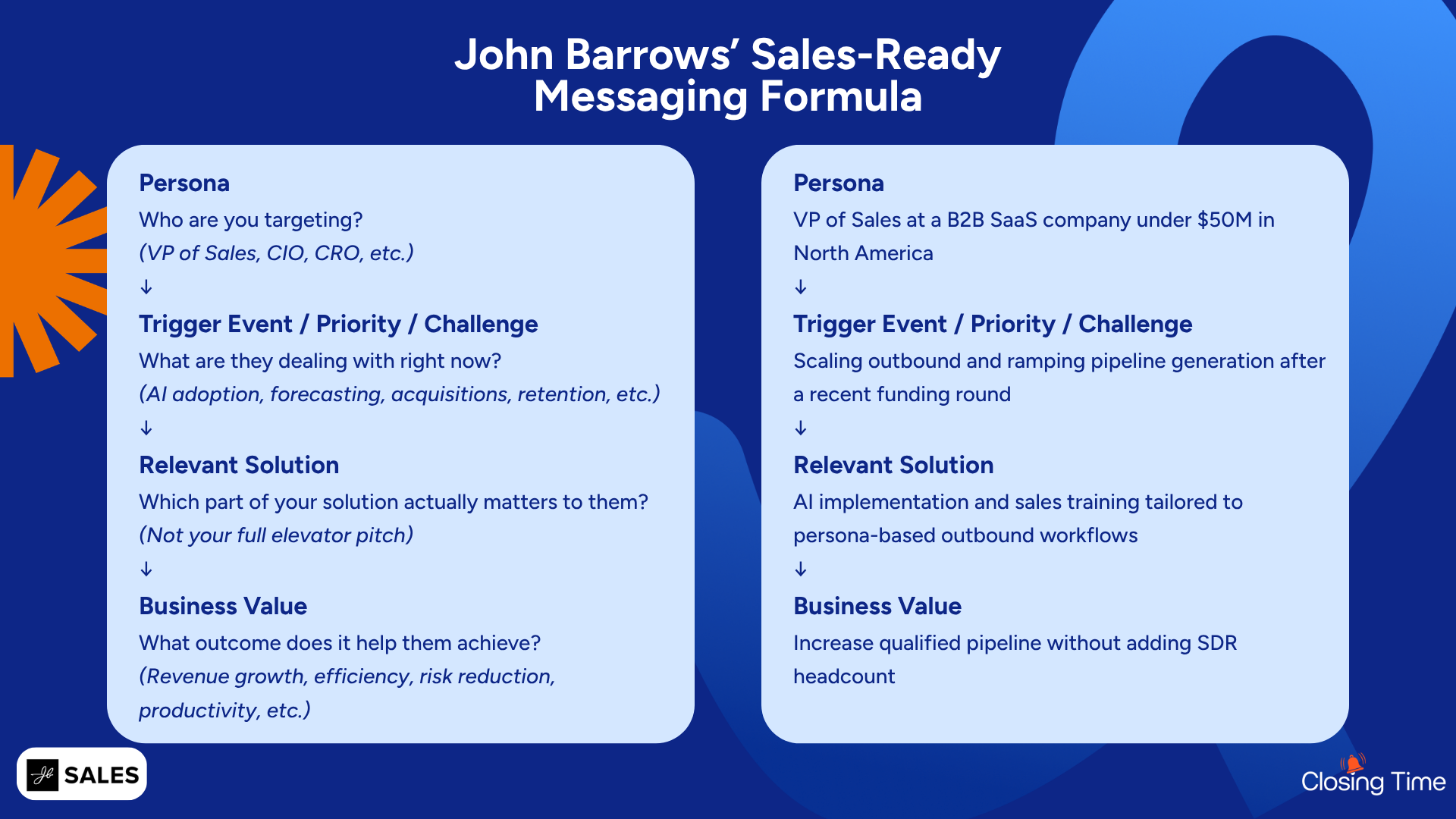
From there, I can build what I call sales-ready messaging. I have a specific formula. Start with the persona, such as a VP of Sales in SaaS. Then look at a trigger event, problem, priority, or challenge. What are their main challenges and priorities? Based on that, what component of my solution aligns with it? What would the value look like?
That equation gets you close.
By researching the account, you can find signals about their priorities, potential trigger events, or past conversations. Then you align the right aspect of your solution to that scenario. You don’t send a generic elevator pitch about everything you do.
I wrote a blog post a while back called “Sell to the 20%,” which reflects one of my fundamental beliefs. Pick any product or service you own, and I guarantee you only use about 10% to 20% of its functionality. Think about your clothes, your car, your phone, LinkedIn, or almost anything else.
Because people only use 10% to 20% of what they buy, that’s how I believe people buy. They care about the part that’s most relevant to them.
You can give me an elevator pitch that includes everything you do, and it may all sound fantastic, but it all drops down to average. In sales, we need to throw darts: not only to wake people up, but so we can tell a story.
If you put everything into one email and don’t get a response, what’s your next email? “Just checking in,” “touching base,” or “bubbling this back up”? That won’t work.
You need to use the insight you have from CRM and previous conversations to understand where the buyer is now.
I’m going through that process myself. I’m looking back through old accounts, scraping what happened, what I sold them, where they were at the time, how things have changed, and who has changed. I’m doing deep research on the business and executives, then creating context that says, “I wanted to reconnect. A lot has changed. I noticed you’re in this role now, and I understand these challenges may be coming up for you. I’ve updated my program to address that, and I’d love to chat.”
## Step 5: Contact Strategy
Val: The final piece is contact strategy. You’ve talked about building it into pipeline stages so the next steps happen more naturally. How does that work in practice?
John: I don’t know about automatically. This is the challenge between quantity and quality, and it goes back to why ICP is so important.
You should segment by tier. Tier-one accounts require a quality approach. I personally don’t believe in automating anything for tier one. If you’re going after a tier-one executive account, AI can get you close, but the human should be the last mile.
Let’s go back to business acumen. Suppose AI writes a perfect email about mergers and acquisitions and your value to a CEO. You send it, and the person responds. Great. Now you book a meeting with the CRO of a tech company going through a merger or acquisition, and they start asking about your knowledge of M&A. If you have no idea what you’re talking about, that’s a problem, even if AI wrote the email well.
We have to understand the messaging that goes out so we can continue the conversation when we get a response.
For me, AI helps prepare everything, but it doesn’t automatically fire. Every morning, I go in, approve or adjust the message, and then send it.
For volume plays, I think you can automate persona-driven sequences, but you need to be very specific. At least three characteristics should be similar: for example, VPs of Sales in SaaS companies under $50 million, or CIOs in healthcare companies with a few specific criteria.
That way, you get a list of 20, 30, 40, or 50 accounts that fit a very specific profile. Then you can build a multi-touch contact strategy and do volume because your cold-calling blitzes are standardized around the same persona and message. That’s where you can automate from a relevance standpoint, but I recommend it as a tier-two approach, not a tier-one approach.
Val: In that instance, reps have confidence because they’re having the same conversation over and over again. That seems empowering for them.
John: That’s the biggest unlock I see when I do call blitzes with reps.
Making cold calls throughout the day is a drastic waste of time because you can’t build momentum or learn much that way. Companies often do power hours, which are great because they create focus. The problem is that most reps bring a random list.
I’m not good enough to have a relevant conversation with a CIO in healthcare, a Director of IT in manufacturing, and a CFO all in the same session. With that approach, I have to be generic. I have to ask, “Tell me about your business,” and give a generic elevator pitch.
But if I call every VP of Sales in SaaS companies under $50 million, I can create a message that is highly relevant to them. I can prepare two or three relevant questions, and I might even have a case study I can use to tell a story.
Then I can get to work. I’m saying the same thing, refining it, and getting better. It’s not just a call blitz; it’s part of a sequence and part of the story I’m trying to tell.
That’s how you see confidence increase. That’s how reps evolve instead of just going through the motions and making dials.
## AI and CRM Hygiene
Val: I’d like to pivot to the obligatory AI questions. We’ve touched on AI, but one thing you’ve said that resonates with me is that companies need to clean up their systems before they can see any real benefit from AI in sales. In practice, what does that look like?
John: I thought AI was going to solve the garbage-in, garbage-out problem. Apparently, it has made it worse.
That’s the challenge I see with AI right now. I heard a stat that around 30% of the content on the internet is AI generated, so you’re compounding the problem. It’s degradation.
It’s the same with CRM and everything else. If your house isn’t clean, you won’t be able to build a bigger house on top of it. There needs to be a hygiene-oriented approach to your CRM and contacts so you’re pulling from the right information and gathering insights from the right information.
Anyone can ask Claude to create messaging based on a website, but that’s usually marketing messaging. I love marketing. My background is in marketing, and I have a healthy respect for it. But marketing messaging is not always sales-ready messaging.
Emails with 15 bullet points, or language about transparency and synergy, don’t land when a sales rep is making a phone call.
That’s why we go through the messaging equation I mentioned earlier. It helps reps learn, solution-map, and get about 80% of the way there. AI can then smooth it out.
Then we take that messaging, broken down by persona, trigger event, industry, and other criteria, and put it back into the system. We tell AI, “When you find these personas and trigger events, use this as a baseline.” The messaging becomes richer and more specific.
If you use tools to track what’s working and what isn’t, you can improve the messaging over time. Keep what works, continue leveraging it, and remove what doesn’t.
The same applies to contacts. It’s easy to turn any system into a rat’s nest if you don’t have a process.
Step one is hygiene. Clean the system. Figure out your ICP. Identify your main personas. Enrich your data with that information. Put messaging on top of it. Then start working.
## Using AI to Surface Prospects
Val: I’d like to get practical because you shared a tactic where Claude surfaces three prospects for you each day. I think our audience would love to hear how that works.
John: This was a major unlock for me.
When ChatGPT first came out, I was all in. As soon as I saw it, I thought it was unbelievable and frightening. It felt a little like Terminator. I created a few useful custom GPTs, but I didn’t have a system in place. I was still using too many tools, and in some ways I was doing more work, not less.
Then I moved over to Claude. From a value standpoint, I felt better about it, and Claude was better for how I work. Around that time, Claude’s computer-use capabilities came out. Code had scared me a little because I’m not a coder. I could probably figure it out, but I knew I’d have to spend time learning it. Computer use was right in the console, so I could work with it.
When it clicked and I got it set up, it felt like the scene in The Matrix when Neo wakes up and says, “I know kung fu.” I thought, “This is incredible.”
Around the same time, I started learning about MCP connectors. Apollo is another client I work with, and I had been meaning to spend a day figuring out how to set it up properly. I like cadence tools, but getting them set up exactly the way you want takes effort.
Then Apollo came out with a connector. I connected it to Claude, which already knew my business, messaging, and background. I asked Claude to go into Apollo and set things up using my persona and messaging.
I gave it my profile and a downloaded list of clients I wanted to target. I asked it to show me three tier-one accounts with full sequences built and personalized based on trigger events. I wanted to log in every day and either approve or adjust them before anything went out. I didn’t want automation. I wanted a setup I could review.
And it did it. I didn’t even have to go into Apollo to make it happen.
That’s where I think the savior of SaaS is coming. SaaS is in a lot of trouble right now, or at least there’s a lot of conversation about a “SaaS apocalypse.” But if you can be the system of record that plugs into a world of MCP, there’s real opportunity.
I think our world will increasingly be Claude, ChatGPT, or whichever AI system people choose. We’ll say, “Go create that sequence,” or “Go do that social work,” and AI will pull in the companies that perform those functions and execute the work for us.
That was the biggest unlock for me because I immediately started using Apollo every day. If I didn’t have that connector, I probably would have set it up well enough, but I wouldn’t have used it the way I wanted to. Now I’m using it exactly the way I want.
The process was identifying the ICP, tightening that, putting it in the system, developing messaging, understanding the sequence based on personas, and then telling Claude to do it.
Val: Are the outcomes what you expected?
John: It’s still not fully there. That’s why I haven’t automated anything to go out.
I might test a tier-two approach in a market that isn’t my main market just to see what scale looks like with slightly better personalization. But it’s still not perfect.
It will write a pretty good email, but then I look at it with my business acumen and experience and think, “No, that’s not good enough.” Then I’ll take the email, put it into Claude, and ask it to do deeper research on the account. I’ll ask it to look into my CRM and see whether I’ve spoken with anyone at that business before, because something feels off and the message is too generic.
It will rewrite the email, and sometimes I’ll think, “That’s it.” I go back and forth with it. I’ll say, “That doesn’t sound like me,” or, “Don’t pretend I know something I don’t know.” Sometimes it will write as though I understand a specific industry deeply, and I have to correct it.
That’s where trust comes in. I do not trust it to interact with clients on my behalf. I still don’t know if I ever will. Maybe that’s because I’m a control freak, but I think the human last mile will always matter to me.
The output is good, not great. It’s much better than it was, and it gets me closer, but I still correct it quite a bit.
And it lies a lot.
Val: I would call that hallucinating.
John: I would love to call it hallucinating too, but it lies.
Val: I’d love to check back with you at some point and see how you continue refining that process and whether you’re getting the outcomes you want.
In the meantime, where can listeners find you if they want to connect or stay close to your work?
John: The website is the easiest place. It has everything: free resources, my YouTube channel, my podcast, and the rest of my content. It’s jbarrows.com.
I’m also on LinkedIn and Instagram all the time. My handle is John M. Barrows. People can reach out anytime. I’ll answer any questions they have.
Val: Thanks so much for joining us, John. And thanks to all of you for tuning in.
For more outbound prospecting tips, keep an eye out for our upcoming guide featuring John Barrows and other experts from Closing Time. Subscribe to our newsletter in the show notes so you don’t miss it.
We’ll see you next time on Closing Time.