




What if every conversion
problem you’ve ever had wasn’t about your design or your copy,
but about the emotional connection the customer felt on your page?
Let’s talk about CRO from a different angle.
On today’s episode of Closing Time.
Thanks for tuning in to Closing Time, the show for Go to Market Leaders.
I’m Val Riley, head of marketing for Unbounce and Insightly CRM.
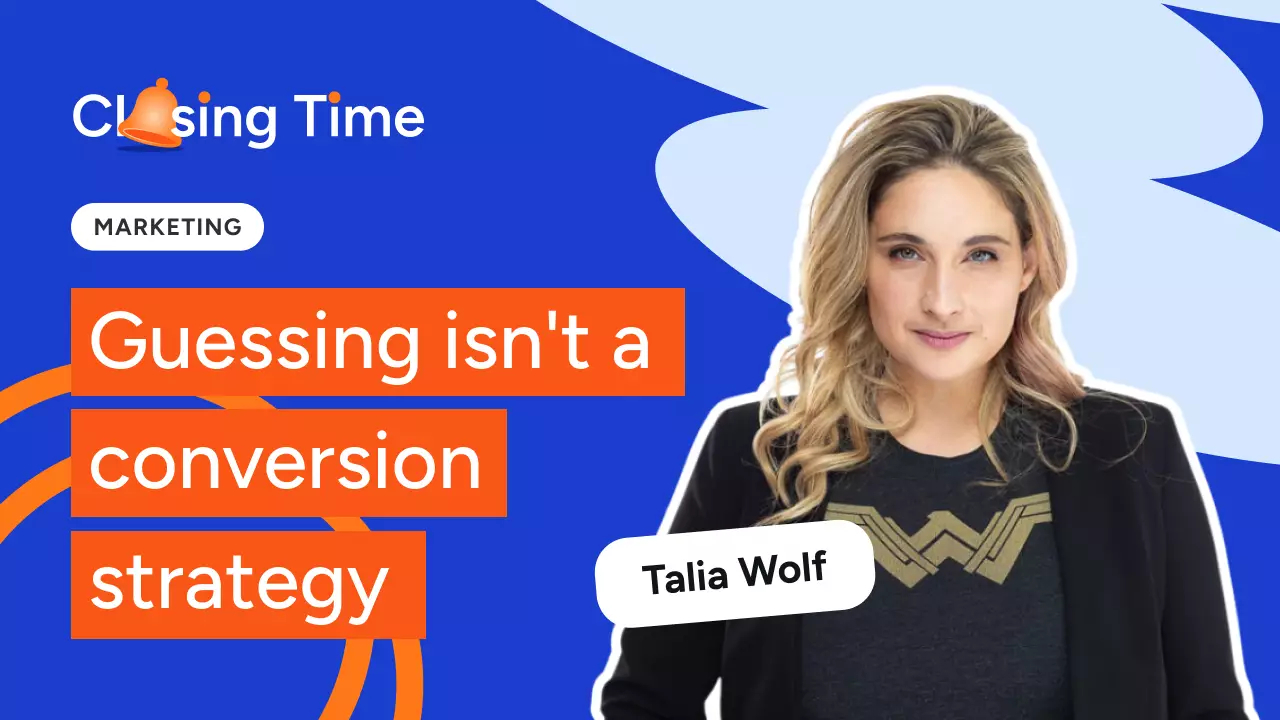
Today’s guest is a conversion optimization pioneer.
She has spent over a decade proving that emotion, not button color,
is the foundation for what drives customers to buy.
She’s founder and CEO of GetUplift, author of the book Emotional Targeting
and a keynote speaker at Google, MozCon, and hundreds of other stages worldwide.
Welcome to the show, please Talia Wolf.
Thank you for having me.
This is so exciting.
I’m really glad you’re here.
I want to start at the beginning, though.
Most marketers are trained to think about conversion optimization
rate in terms of tactics like AB testing headlines,
tweaking CTAs, shortening forms, removing friction.
You’ve built your entire career on the idea that there is
a fundamentally different approach to CRO.
What did you note early on that made you realize that maybe
conventional CRO was missing something?
Yeah, that’s a great question.
When I got started,. I was doing all that stuff,
so I was trying to change the color of a button or move some elements
around on the page or change an image, and I’d hope for results.
But what I discovered early on was that if I wanted
to increase conversions and really help our clients, I had to understand
why people buy from them, what actually drives them to buy things.
And one of the initial things I understood is that conversion
optimization isn’t actually
about changing elements on the page in order to increase conversions.
It’s about solving people’s problems.
So if I can understand the audiences and the prospect’s
problems, their challenges,
their concerns, the hesitations, what they’re trying to feel,
then I can optimize the entire customer journey based on that.
So instead of just playing with it like a puzzle, it’s understanding
the customer first and then creating a customer journey
for them that’s really built for the way they make decisions and helping them
make a safe decision that they feel comfortable with.
All right.
I think that brings us to your three step emotional targeting framework.
Step one is research, but you’re clear that this isn’t
your typical, like, demographic research, right?
Walk us through what meaningful research actually looks like
and where marketers should actually be looking for those emotional insights.
So one of the most important things. I understood
was that every decision that we make in life is based on emotion.
Whether you’re buying something for yourself or for a company,
there’s always emotion involved.
And I understood that in order for me to increase conversions,
I need to understand what is driving those emotions,
why people buy the psychology behind the decision.
And step number one is research.
During the research we’re not just looking at data and
and quantitative information.
What we’re looking at is qualitative data.
And in this instance what we’re looking for is actually hearing
how people describe their own pains, their own challenges,
how they want to feel, how they feel
right now, how they want to feel about themselves
or how they want other people to feel about them.
So the research is really deep into
interviewing your customers and doing surveys, polls,
but most importantly, doing something we like to call social listening.
And social listening is essentially combing Reddit, LinkedIn,
YouTube, discord, Facebook in order to see real, authentic conversations
that people are having and seeing how they make decisions
and what they actually think about the industry and about competitors
and about the brand, and really piecing together how people make decisions,
and then using that in order to optimize our websites.
So yeah, step number one is definitely that, just
diving deep into understanding who we’re actually catering
and how they feel and what they’re looking for.
You know so many people want to bash social media.
I was doing marketing
in a pre social media era, which I know dates me quite a bit.
And the truth is we didn’t really have access to that type of data
unless you did, like a research study, like a, a qualitative research study.
And a lot of times people aren’t really honest.
They answer those studies
with what they think they should do or what they think you want to hear.
So I really do believe one of the benefits of sites like Reddit
and even social media sites is we get a lot of insight into people’s emotions,
and they’re just putting it out there for us.
Whereas literally like 20 years ago, it was a really hard to get
that information.
Absolutely.
And I would say that the entire emotional targeting framework actually came
from those original marketing campaigns for offline campaigns.
You know, the ones that you’d see
and you still do on television and on the radio
where you couldn’t actually measure things but they’re all driven
by emotion,
and they’d all do very robust, big research pieces to understand customers
and speak to them and go to where they are and actually spend time with them.
And my goal was to create a process
that would help me do that online.
At that is, you know, right now everyone considers
these spaces like Reddit and like Quora and like Facebook,
the places that authentic conversations are happening.
So people are really talking about how they make a decision,
or they’re talking about what, you know, keeps them up at night
or what annoys them, or what they love about a brand.
And that is where the goldmine
really is, and just understanding that and simply
reading through it and even seeing, hey, is my brand even mentioned?
Are my competitors being mentioned?
Is it positive? Is it negative?
What is what are questions that people are asking, on Reddit that we
don’t actually answer on our website or in our emails or in our FAQ.
And these are questions that we should
we should be writing content about that stuff.
So, it’s just a goldmine.
Yeah it is.
And I think you used an interesting word there, is authentic.
I think people are being authentic on those sites.
And so it really does drive it home even more.
Okay back to the framework.
Once you’ve done your research
you actually understand what your customers are feeling.
You move into step two of the framework, which you call the emotional
Targeting audit.
This sounds quite different from like a typical CRO audit
that just checks like is your CTA above the fold?
How is your page speed?
So what are you actually looking for?
And when you audit through like more of an emotional lens?
So that’s definitely part of it.
When we talk about a, a CRO audit.
Most people do jump immediately to, okay, how you Ristic audit a UX audit.
Best practices, speed.
So we do that stuff, but we go a much deeper layer.
And that is an emotional targeting audit.
And that is once we have all the insights about the customers
and we know them better and we understand really why they choose
one brand over another, then we’re able to actually
look at the website with fresh eyes in our customer’s eyes
and ask ourselves the important strategic questions like
are we making it about ourselves or are we making it about the customer?
Are we telling the stories that people care about?
Are we highlighting the outcomes people actually want, or are we actually,
discussing the pains that they feel?
All that stuff is how we are able to figure out
what’s not working, because the most frustrating thing about conversion
optimization is that there’s so many blog posts out there telling you
how to fix a landing page of what to do, but there’s something’s not working.
You’ve tried all the stuff you’ve done, all the things that these blog posts
and gurus are telling you, and it’s still not working.
And what’s missing is that emotional layer.
It’s that strategic layer.
We’re constantly looking at pages like elements and not stories.
So when you want to actually understand, okay, why aren’t people converting?
You need to ask yourself these strategic questions
in order to really see from your customer’s eyes.
And that’s what’s great about it is because once you do this audit,
it’s really much easier to identify why people aren’t converting,
because you’ll clearly see,
oh, I’m using social proof that just doesn’t connect with people.
I’m I’m focused on an outcome people don’t actually care about
or they assume is already, you know, going to happen anyway.
Or I’m focused on these features or I’m telling these stories, I’m
highlighting these things that people don’t care about,
and it just pieces the puzzle together for you
so that you’re able to clearly see why people aren’t converting.
And then you can run more meaningful tests, which is the third step.
I was going to say that’s a
great segue because we’re going to the third step is testing.
And again you’re saying this isn’t about like the button color
or the hero image or whatever.
But when you’re testing how you’re testing basically the emotional
targeting that you’ve done to make sure you’ve hit on the right points.
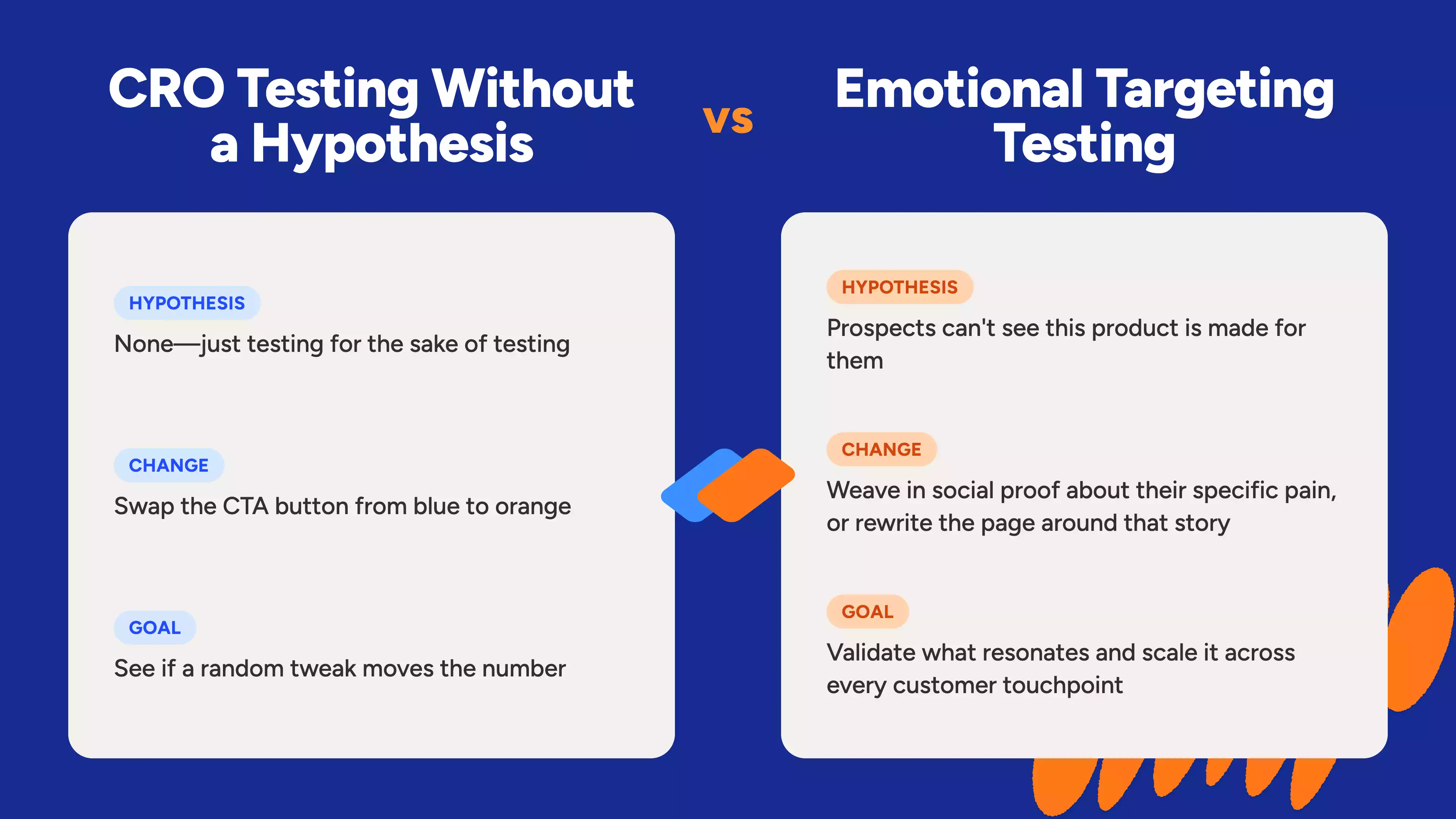
So the idea of running meaningful tests
is that you’re not testing for the sake of testing.
You’re not just asking, okay, what should we test next?
But you have a hypothesis.
You have done your research, and now you know, for example, that people
your prospects can’t easily
see that this product you’ve created is designed for people like them.
They can’t clearly see the difference between you and your competitor
because everyone’s saying the same, looking the same, using the same AI stuff.
And it’s hard to tell the difference between one product and the other.
So now you have a hypothesis, and now it’s so much easier to run a meaningful test.
Meaning it’s not just let’s, you know, change the button or remove the form field
and hope it works.
But you’re saying, okay, let’s try an experiment where we’re
weaving in social proof about, the specific pains that we’ve uncovered.
Let’s try rewriting the page in a way that focuses on these pains
or these hierarchies or these, results that people want.
So the idea of running a meaningful test is that you’re not just running it
for the sake of running it, but you’re actually coming into it with a hypothesis
and that you’re learning from every test, because you could have a hypothesis
that says, I think people can’t clearly see that this product is for them.
And you could try one thing and it won’t work,
but the hypothesis still stands true.
You just have to find a different way to show that on the page.
So you try some testimonials and that doesn’t work.
Or maybe you try a different story or a different angle,
a whole different, customer journey or a whole email sequence.
But the idea is that you learn from every test that you run
and that once you do get interesting results,
you’re able to give them to everyone in your marketing department, from product
marketing to even customer success and sales are all learning
from your tests and able to talk to your customers in the same way.
So the entire customer journey is aligned.
So you’ve once again popped into my next question.
But I think it’s great because exactly what I was going to say,
you know, we talk a lot at Unbounce about landing pages, but
it really has to be the full customer journey.
one thing that we’ve
we haven’t covered yet is, you know, that concept of land you don’t own, right?
So you mentioned the customer journey, not just the landing page.
Maybe it’s the email sequences, maybe it’s the sales sequences,
maybe it’s the script the sale sales team is using.
But but, on, you know, rented spaces.
How do you manage or
use the optimization on those spaces, that are outside of your control?
Yeah.
So I think first, it’s important to say
that we do actually have to be on those spaces.
So forever and ever CRO has always been optimization has been
about optimizing, as you said, the lands that we own, the assets that we own.
But now the decision to buy, whether you’re buying
a landing page builder or you’re buying accounting software
or a dog leash, has moved off of the website,
so people are making decisions before they come to your website.
And when they land on your website, they already have formed
opinions and emotions about you.
And so it’s not enough to just optimize your website
and your landing pages, which you absolutely have to,
but you also have to be in those spaces where people are making decisions.
So if your audience is out there engaging on Reddit
or on discord or on YouTube and commenting on stuff,
you have to be there not just to learn and gain insight about them,
but also shape the narrative meaning having conversations, engaging
with people, shaping and actually being comfortable
with having conversations that don’t link back to your website
that don’t have direct attribution, but just being in those spaces
because you want people to see you for who you are
and presumably you have a great product.
So you want people to know that.
But if you’re not there, someone else is controlling the narrative.
Someone else is deciding what people will feel about you.
And you can start by doing that with even your social media.
So engaging in social media on different platforms
and actually seeing how people respond to stuff,
and then also answering people on Reddit and then also maybe commenting on YouTube,
but doing all that stuff create a cohesive customer journey
so that what people learn about you off of the website connects
with what you’re saying on your website, or your landing pages or your emails.
So yeah, conversion optimization isn’t.
It isn’t just about what you own anymore.
You have to be everywhere, all at once, all the time.
I think this is even exacerbated
by, you know, AI search, GEO, whatever you call it.
You know, so much is happening, within those LLMs
and you can just influence that.
But your website is where, you know, people go to get information about you.
But more importantly, sometimes where those LLMs
go to get information about you.
When, when I if you had told me even eight years ago
that I would have a budget line item to have somebody monitoring
Reddit for our company,. I would have probably told you
you were a little crazy, but it is so important.
That’s one of the main sources for a lot of these LLMs.
And you have to, like, manage your relationship there.
Yeah.
And I do think that this is a great opportunity for small brands.
So forever and ever we’ve had the situation where the biggest brands
have the biggest name and they can say whatever they want,
but now they can’t hide behind a polished website anymore.
And LLMs are telling people how to feel about you and want to think about you.
But if you’re a small company or you’re just getting started,
you have the opportunity to shape that conversation on Reddit
to be the first one who doesn’t have brand guidelines
and all sorts of rules about how to discuss things,
and you can be there and shape the narrative
and be the one that kind of dominates that.
So I think that there’s a lot of things
that I do not like, and that is an understatement about AI.
But it does force many brands to be real.
And authentic,
because a lot of brands, for example, don’t want to talk about their pricing.
But now if you go into an MLM, it will just tell you the pricing.
Yeah. Well.
So you can either own that yourself and talk about it and be real about
it or the internet will.
opportunity here
because of zero click marketing and because of LLMs,
to start optimizing off of the website
and actually own the market by being there and engaging in those conversations.
Yeah.
I really feel like this is a huge opportunity for what I call
challenger brands.
Brands that may not like you’re saying, have the largest budgets
or the most historical context
where traditional search models favored those brands.
I do feel like
GEO is giving an opportunity to challenger brands to be authentic, to
to be in the conversation where really it was getting a little
cost prohibitive for a lot of challenger brands for a while.
So I think that’s a huge opportunity.
Agreed.
So, any other tips?
You know, like
if you look at your resume, it’s very impressive,
but you’ve worked with a lot of big brands.
So, in addition to being on Reddit or,
you know, some of those other social sites,
are there any other possibilities for some smaller
brands to take something away from our conversation today?
Yeah, I would say the most important thing is research.
Do not skip do not pass go.
Very important.
The research is what sets you apart from everyone.
While everyone is using AI to write their copy.
And you, you’re probably noticing, and I’m seeing this in every industry,
how all competitors and everyone in your industry is kind of blending into one
wishy washy sentence, and everyone’s saying the same stuff and it’s
getting harder and harder for consumers to tell the difference
between you and your competitor.
So the research is what’s going to set you apart
if you do the hard work, and there’s no way around it that it’s hard work.
But if you do the hard work,
you’re going to have so much more information about your customers
and how to speak to them,
and what words to use and how to relate to them than anyone else.
And you can then do everything we discussed.
So the most important thing is research.
And if you’re you only have one hour this week, do a survey
or spend one hour on Reddit just reading through threads..
Don’t even try and analyze.
Just go through the thing and read it and read it and consume
to see what people are saying about you, how they’re talking about you,
what the narrative is, what the negative and the positive things is.
So there’s so much you can do on a zero budget.
All right.. So that’s your challenge for this week.
Everybody out there, Talia saying if you have one hour,
that’s your assignment and you’re going to learn.
So much.
Talia, this has been such a great conversation.
I feel like I need to go immediately and, you know, go audit
all of our landing pages.
Before I let you go, where can people find you,
follow your work and learn more about GetUplift.
So, there’s a couple of places, obviously, you can go to getuplift.co
You can also go to taliawolf.com where you can get my book and you can see
you can get a bunch of resources.
And of course you can connect with me on LinkedIn or Instagram.
I’m always around or on my podcast, Heart Before Cart.
Awesome.
Again, thank you so much.
That’s a wrap on today’s episode of Closing Time.
If this conversation sparked something for you,
be sure to share it with the team. Work.
Maybe someone who’s stuck in a button color testing loop.
Remember, you can get this episode in every episode of Closing Time
delivered right to your inbox.
Just click that link in the show notes and we will see you next time.