




What if AI took over every task you didn’t want to do in the first place?
Today on closing time, we’re taking a peek into an AI native
marketing agency.
Thanks for tuning into Closing Time, the show for go to Market Leaders.
I’m Val Riley, head of marketing for Unbounce and Insightly.
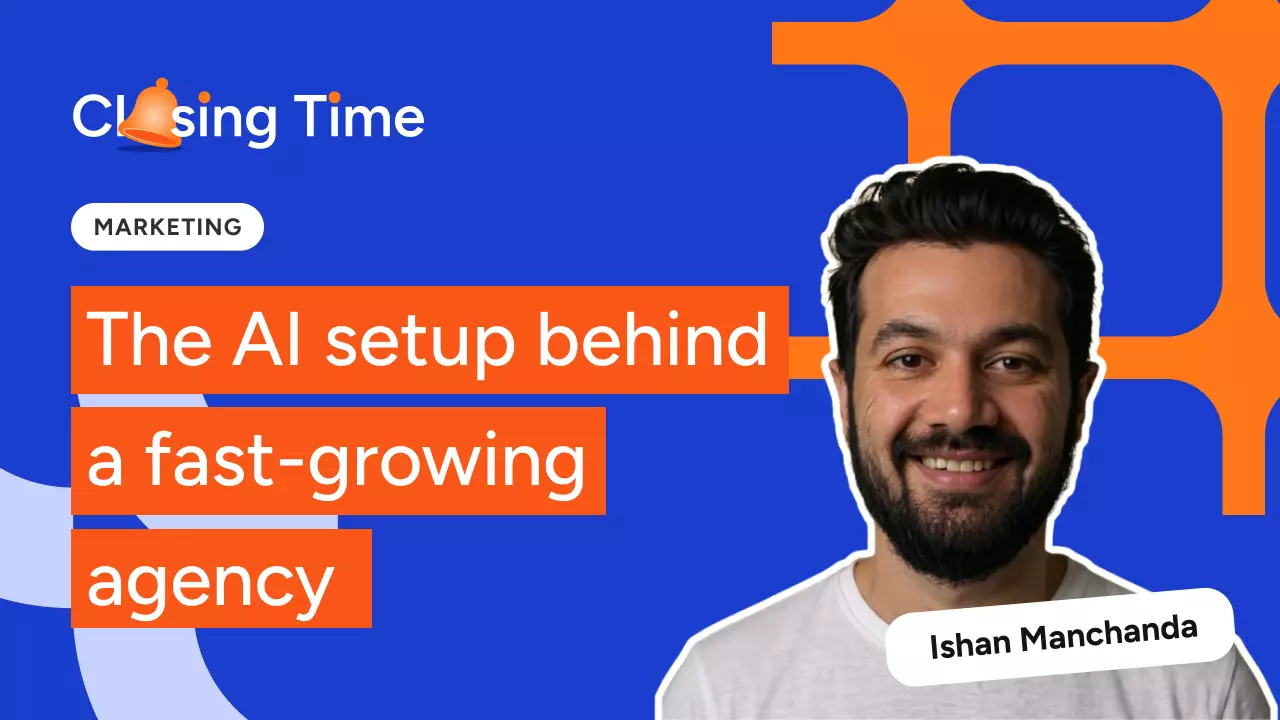
Today, please help me welcome Ishan Manchanda.
He is co-founder of Growth. Spree in AI Native Growth Agency
that has helped more than 300 B2B companies turn marketing into a pipeline.
Ishan, welcome to the show.
Thanks so much, Val. Excited to be here.
Well, let’s dive right in because there’s a lot of anxiety out there
about AI taking marketing jobs, but I want to flip that on its head.
When you look at agencies
and marketing teams today, what should AI actually be doing?
And I’m talking about the work
that frankly, human beings really just don’t want to do.
Absolutely.
I’ll put it exactly the way you said it, right.
The AI should definitely be doing the task that humans
were never supposed to be doing, but we just didn’t have an option.
Today we have an option which is AI and we should be utilizing it.
So tasks like,
you know, if you’re in marketing, if you’re running an agency,
working for an agency, like building reports, doing like keyword
research, optimizations,
So any kind of manual operations should definitely be done by AI.
But how quickly AI has evolved and with all the models that you see,
with ChatGPT and,
specifically Anthropic Claude putting out there and their capabilities,
AI can do a little much more than, you know, just the manual operation.
So things like root cause analysis, right.
So you were getting a good bunch of leads and suddenly the lead stopped coming in.
Why did that happen?
What went wrong?
And you had already done 50 things which probably led to this downfall, right?
So getting those directions, improving your horizon,
your inspirational horizon, what next can I do with respect
to creatives and positioning
and the content that goes out, those also start coming in from AI.
For us, the job is which should have always been
to use this brain, which is what helps us stand out as human beings.
Right?
And just drive. AI to do all of these things in the way
you want in a fashion that it delivers the best outcome for you.
that’s a great way to put So let’s draw a line between agencies
that are using AI and agencies that are AI native.
On the surface, those can kind of sound like the same thing.
Everybody has ChatGPT or Claude licensed these days.
But walk us through the difference.
What is an AI native agency look like from the inside?
Absolutely.
I think an AI powered,. AI assisted agencies
do not exist in 2026, right?
A marketing agency today is using some way or the other using AI, right.
So you rightly mentioned, you know,
everybody has that ChatGPT,. Claude license out there.
What makes it AI native?
I’ll actually put it in a way to help you understand the gap.
So you first layer is you being able to use ChatGPT or any LLM.
As a matter of fact. Right.
Just prompt and just get some things done faster than earlier.
Then let’s say I’m, you know, I’m pro. Claude user right.
So I’ll talk about Claude and the features there.
The next layer is probably building skills. Okay.
So skills is repetitive tasks that you can do.
And you just
make sure that the protocol is ready and you can keep doing it again and again
and much faster. Right.
Then a layer probably I’ll put MCP servers right.
So connecting MCP on your LLM and then being able to talk to different tools
and finally having your own proprietary tools, we are there.
Right.. So we have our own API, proprietary tools.
I’m not saying we don’t use. AI at different layers.
We use MCPs.
We use Claude LLMs just for prompts and just to get some things done faster.
But we also have proprietary tools which help us
create a separate ecosystem for every client that comes in.
Right.
So that begins with onboarding their brand
guidelines, their brand documents, their ICP,
all the context and most importantly, their CRM onto our ecosystem.
The ecosystem is backed by a lot of automations we built on.
The tech team has built custom, and we also have a front end app.
But at this point of time, clients do not really see this
ecosystem completely, but internally, this is what drives us.
So there is a source of truth, which still remains a CRM.
But every operation that is happening and stitching all of the funnel
together from ABM, from match to from content,
that is something that we build like an OS
or like a single brain for each of the client.
That’s why we call ourselves. AI native today.
Wow. It really does feel like that’s probably what
agencies have been striving for, you know, maybe for decades.
But now AI really has made it a reality that you feel like you’re getting
that extremely custom, customized experience from your agency.
So I’m sure that’s very well received by clients.
Absolutely.
I think two sides to it, right.
On the client side, definitely.
Now they can expect more.
They can not
they do not really have to wait for 4 to 6 weeks of onboarding, which
a lot of the traditional agencies have been doing for a lot of time.
Now things go live in ten days in two weeks, right?
All because as an agency,
we have a system in place which can deliver faster, right?
But I don’t think
AI is helping us deliver better, right?
It’s definitely helping us deliver faster.
It’s definitely influencing us or helping us become better.
But the outcome, which is as as an organization,
we are able to deliver to
each of our clients that still remains in the hands of the human experts.
My team that works on each of the clients day in, day out. Right.
And there is another side which AI is helping, right?
And which is our own business as a service business.
We’ve been waiting.
Every service business has taken 2 to 3 decades to reach.
At a certain stage, this growth is immensely slow,
and that’s what the first four years of our operations look like.
Slow growth.
It wasn’t good. Yeah. Good. Definitely.
But was it something that excited us after the second year?
Honestly speaking, no.
Before AI came in and you know, in that public domain,
we were actually struggling to understand how to scale this up.
And today we can we can surely say that we are looking
and are forecasting us to grow
like a product company while maintaining the quality of an agency.
I mean, scalability is where it’s at.
That’s that’s really exciting.
So I know some people are listening and they’re like, well, how can I apply this?
So you gave me a really concrete example when we were talking earlier.
I’d like you to take us through it.
So this is like you have a client call and then what does
AI kick off in the background after that client call?
Maybe it’s a prospective client that you have set up to.
You know, like we said, take away some of that
that work that no one wants to do.
Absolutely.
Glad to share that across.
And it’s a simple, simple workflow.
And this is at the probably at the second and the third layer
of how I define the entire,. AI native journey.
So when I get a call this is on the sales side,
not on the marketing side, but on the sales side.
When I get a call,. I have like a note taker app,
like fireflies on my call all the time, which gets automatically added.
I think everybody has a note taker, right?
Fireflies also has its own MCP.
Now I’ve connected that MCP server on my Claude.
Okay, so when I’m done with the with the client call,
my next steps generally involve me to build a proposal.
I would basically send out an email talking about the services.
We offer all of those things.
Right. For a very long time,. I didn’t like that.
I always took a day extra and would spend time
and rather draft a proper proposal, like a proper plan for my client,
and I generally would take like 4 to 5 days to do it right today.
As soon as I’m done with the call,. I have the fireflies app.
It’s taken up, picks up all the call transcript.
I have a certain level of understanding and a strategy
that I want to give as input.
A, that already is a part of the call, because I’ve already spoken
about everything that I want to, and I always do that right.
So it’s already there.
I have some nuances that I want my LLM, my Claude to understand.
I share that.
I have my skills already ready, so if I’m sharing like an AI proposal,
I have a skill for that which audits, identifies computers, does
a competitor research, identifies the features that we offer our offerings.
Overall, it’s a productized service and builds a proposal.
Very custom, very detailed.
Similarly,. I have a skill for paid media proposal.
I have a skill for ABM.. These are certain offerings that we have.
So it picks up the skill,. It builds the proposal.
The proposal is ready after the call.
In one hour. I am ready to shoot out an email
which is not a generic tech, not generic case ready.
Now, I exactly know who. I’m reaching out to.
What is that they’re looking for, what industry and market they are a part of.
And I have a in depth proposal which is for them right.
Ready to use.
I mean that’s fantastic.
It really does get you to spend your time on the parts
that are the most meaningful and,
but still delivers a quality communication.
So let’s switch gears a little bit.
I mean, I mentioned that at the top of the show,
I’m the head of marketing for a software company.
We have two applications Unbounce Landing. Page Builder and Insightly CRM.
And this next topic is all I’m working on right now.
We’re rolling out. MCP model Context Protocol servers.
Right now, every B2B SaaS company is either doing this
or has done it, or is probably releasing it in the next month or so.
So for someone hearing that term for the first time,
it sounds like you have a web of MCP connections
in the background facilitating the workflows that you’re talking about.
Can you just.
Can you just share why software companies are rolling them out at such a fast pace?
Absolutely.
So first let me start with what an MCP is like.
MCP is like model context protocol.
Simple to understand.
It’s like a bridge between your LLMs and the tool.
Different tools possibly. Right.
So for example as I just took an example for fireflies.
Right.
So fireflies has an MCP, that means the MCP
is a bridge between my Claude, my LLM and fireflies.
Right?
Anything that I prompt on my LLM,. MCP understands it.
That is the protocol part of MCP that comes in.
It has a protocol of understanding the prompt and accordingly figuring out
the features and resources available and getting you the answer right.
So now it’s basically APIs is something that I think
all of the user base would have heard of a lot, right?
You can imagine this similar to API, but actually it’s actually replace
all the APIs, right?
It’s a direct connection between your tool and the LLM.
Why should you trust my definition?
It’s not just that we use MCP servers.
We actually have built our own MCP server.
And we’ve actually gone a layer up
where we’ve connected multiple MCP servers together and stitch them out together.
And we’ve built MCP servers for Google Ads, LinkedIn ads, Meta ads,
HubSpot as the CRM, Search. Console, and Google Analytics.
And this all stitches together.
So on your Claude you can simply ask, let’s say,
what is the impact of LinkedIn ads on my direct traffic, right?
This is a big question
that every marketer is asking who’s running LinkedIn ads, right?
Because we are not getting direct leads from LinkedIn, apparently.
Right.
So these kind of questions it’s able to answer because it is access
to all of your marketing tools and the stack.
Right.
This is something we’ve built.
Now to answer your final question, right.
Why why is everybody building this?
I think it has to do with the fact that there is a drastic transformation.
We’ve already we are already in wherein our as users are
way of interacting with the internet has changed, right?
And we are on LLMs, we are searching there.
We are spending a lot of time there. Right?
If you, Unbounce, wants to sell to, you know, B2B marketers agencies, right?
They are spending their time on Claude and ChatGPT
now you want to be where your users are, right?
The typical textbook marketing one on one right.
Be where your customers are right.
Your customers are on Claude, your customers are on ChatGPT.
So how can you be there with and adapt to the change,
which is they don’t
now want to open your another platform and build something separately,
and then get the output and try to stitch everything manually together.
Everybody, as you know, and you yourself,. I’m sure we’ve been frustrated with,
you know, manually stitching things together
over Excel and trying to identify what is working and what is not working.
And I think that is the biggest reason. MCPs have come in.
It’s just made life on the other side.
For me as a marketer, it’s made my life super easy.
I’m on one platform.
I’m doing everything right there.. All right.
So let’s talk about adoption,
because I think it’s safe to say you’re a little bit ahead of the curve of
maybe some agencies and certainly some marketers
and marketing teams that are out there right now.
So if what could be a quick win or what do you see as marketers and agencies,
what opportunity are they not taking advantage of right now?
I think
falling in the trap
you know, where you started the podcast, it AI is taking away jobs.
I think the mindset where you’re the trap, the mindset that you are in right now,
where jobs are going to go and AI is going to replace you.
That is what I think is leading to a lot of downfall in terms of,
you know, people being scared, people not being able to perform and
most importantly, missing out the wave, which is the AI wave today.
Right?
History has spoken again and again and again.
Similar scenarios.
The world has been multiple times.
The internet era be disaster.
The even the machine revolution that came in.
Right?
We everybody was scared.
Everybody was skeptical.
But the people who took advantage,
people who took the bet, actually became big, right?
So if you want to become big,
stop cribbing about. AI is not giving the right answer.
Stop giving excuses around you know you can’t trust AI.
You don’t have to trust AI.
You have to trust yourself.
And you have to trust yourself to use. AI to your advantage.
If you can do that,
I think you’re going to make it for the next five years for sure.
Well,
speaking of the next five years, I’m going to ask you a crystal ball question.
If AI native is the bar right now for agencies and winning marketing teams
a year or two from now, what do you see that we’re maybe doing differently
or better with. AI than we’re doing right now today.
I think the AI native term also in the coming years is going to vanish away,
and just the default setting would be having your own proprietary tools.
And we see a lot of agencies.
We started doing it last year.
We see a lot of agencies, our competitors now bringing up their own,
you know, infrastructure in AI tools in the market?
I think it’s going to become a norm.
And that is why our bet was never AI.
Our bet was always the service that we offered.
AI was and has been a great medium for us to improve our go to market motion,
to improve our internal operations,
to actually think about scalability as a service business.
But end of the day, three years, five years down the line, when
and how we see AI improving day by day,
our role is going to be much more critical.
And by our. I mean every every B2B marketer.
If I talk about the domain, our role is going to be
much, much more important in being able to differentiate
our brand compared to our competitors, in able
to look at guerrilla activities, because you will have to stand out.
There will be a lot of
the things we are not able to do today that everybody will be able to do.
So then you will figure out other things that you should be doing differently,
and our role will be much more important in terms of how we use
AI is just going to be a medium.
It’s going to be our brain, our exposure,
our level of strategic thinking that’s going to be actually challenged
now, because for a very long time, we always had the excuse of saying,
you know, I didn’t have the bandwidth because it took me x hours to
build the campaign.
So I couldn’t really, you know,
think about two different positions that we could have tried.
It’s all gone. You know, that’s all sorted, right?
So can you think of three use cases?
Experiment fast, fail fast.
Understand better, try different things, try different angles.
I think that is where the again,
for agency sake, I think the future is.
The winner will be.
Yes. People who adapt to AI who take it as a medium to build scalability,
but the winners will always be the ones who deliver better as an engagement model.
I love your perspective, Ishan, and your optimism.
It is pretty easy to go out there and find a lot of gloom and doom.
So the way. I’m hearing it, you’re talking about
AI is just going to accelerate the work that we’re already doing,
the great work we’re already doing.
So thank you.
Thank you for that dose of optimism and your perspective.
If folks want to find and learn more
about you or GrowthSpree, where should they go?
Yep, you can find me on LinkedIn.. Probably.
We’ll have the link in the description and
you can find about GrowthSpree at GrowthSpreeOfficial.com.
Just visit the website.
You can book a meeting directly with me.
It’s not a demo. It’s not a pitch.
You can always just book
a 15 minute, 30 minute meeting with me just to have a conversation.
If you found something that I spoke about and you, addressed you and you want to go
deep, I’ll be more than happy to have a round of conversation with you guys.
Thank you. Sounds good.
Thanks for sharing your playbook.
Marketing leaders.
Agency leaders.
Let’s get rid of the busy work.
Let AI do that for us, and really get to the good work that we actually want to do.
Ishan, thank you so much for joining us.
Thank you so much, Val, for having me.
It’s been great and I wish you all the best for the rest of the series.
Appreciate that.
And thanks to all of you for tuning in
to Closing Time. Remember, you can get this episode
and every episode delivered right to your inbox.
Just click the link in the show notes and we’ll see you next time.