





Folder highlights
Transcripts detail “Closing Time” podcast episodes discussing 2026 go-to-market, sales, and AI trends with various experts.
How does a digital agency scale landing page output
accelerate experimentation and support complex conversion flows,
all without leaning on developers or client web teams?
Let’s hear from a customer in this episode of Closing Time.
Thanks so much for tuning in
to Closing Time, the show for go to market Leaders.
I’m Melinda Prescher
senior director of product and customer marketing at Unbounce and Insightly.
Today, I have the pleasure of hosting a special Customer
Spotlight edition of Closing Time with Found search marketing.
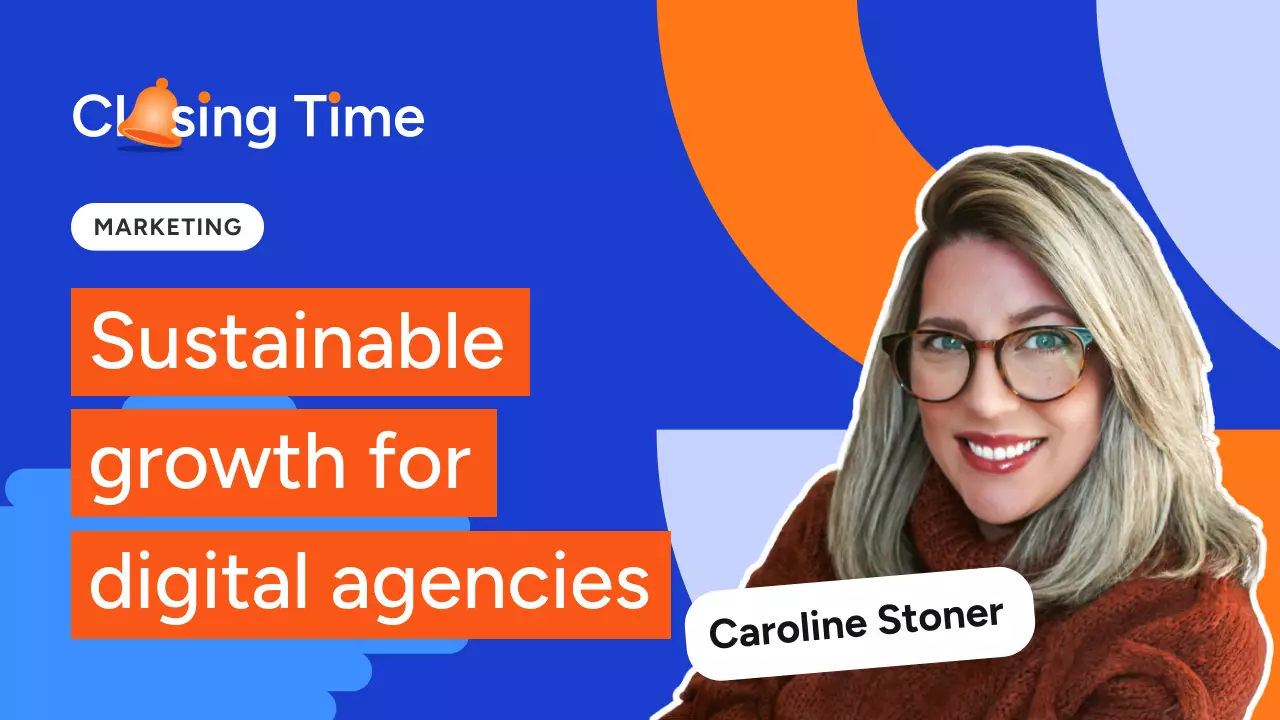
I’m joined by Caroline Stoner,. Director of User Experience.
Caroline, welcome.
It’s so great to have you here.
Hi, Melinda.
Great to be here.
Caroline, for those who may not be familiar.
Tell us a little bit about found search marketing.
Found Search Marketing is a paid media agency founded about 20 years ago
by one of the very first employees on the Google Ads team.
We’re based just outside
of Indianapolis, Indiana, with nearly 50 people across the country.
Last year we managed 200 million in annual media spend.
And what really sets us apart
is how deeply data is embedded into our paid media strategy.
We’re not just optimizing to clicks or channels.
We use first party customer data to inform targeting, bidding and measurement.
So performance is constantly learning and improving.
That approach helps us reduce wasted spend
and drive more consistent, qualified lead growth for our clients.
My role specifically is focused on making sure
that same performance mindset carries through after the click
my team owns how paid media strategy shows up in the landing page experience,
and how we use experimentation to keep improving over time.
When media, data and testing are all working together,
it creates a much more accountable and scalable system for growth.
And that’s really what Found is built on.
So, Caroline, I noticed that you’ve been with Found Search Marketing
for about eight years, and your role has evolved a lot since you started.
How did you move from landing page specialist to director of user experience?
Yeah. It’s been quite a journey.
From the beginning, my role has always been focused on
specifically landing pages in experimentation,
and that kind of core has not changed.
But when I first joined, found,
I was completely in execution mode.
I was building landing pages in Unbounce, a platform I had heard of,
but I haven’t really used yet, and running the occasional
AB test while I was still learning CRO.
But once I started to see how even small changes
could make a meaningful impact on performance, I got pretty hooked.
So I spent a lot of night digging in, studying competitors.
Clicked on many ads.
Probably wasted a couple hundred dollars there.
And learning from the broader. CRO community.
More specifically, the Unbounce community and experimenting
as much as possible as we started to run more experiments.
The results started to compound.
we saw consistent wins that really opened everyone’s eyes to what landing pages
could be when they’re treated more as a growth lever than just a deliverable.
From there, the work naturally scaled.
The team grew.
We brought on more clients, and my role shifted from just doing the work
to building the system and teaching others how to think this way.
That evolution into leading UX was driven by a curiosity,
dedication, and truly a genuine passion for not just good
looking landing pages and good design, but also design that performed.
I love to hear it.
Let’s pivot.
One of your largest clients requires highly detailed qualification flows,
some with even up to 16 form fields and conditional logic.
How has Unbounce allowed your team to support these complex
user journeys while still optimizing for conversion?
Yeah, it’s true.
We do have a form that is probably even more than 16 fields at this point.
It’s definitely a fun challenge, and honestly,
one of my favorite things to work on, but these kinds of qualification flows.
The goal is never to remove the form fields.
Unfortunately, those leads need to be super qualified
so that work becomes more about how you design the experiment
around the complexity in a way that still feels manageable for users.
Early on we used to Unbounce’s native form builder,
and it worked really well for what we needed at the time,
and it still does for many of our other clients.
As our clients requirements evolved.
More fields, more conditional logic.
We leaned into Unbounce’s flexibility
because Unbounce gives us full control over the whole page.
We’re able to bring in custom built forms while still keeping everything else
we rely on like fast iteration, easy updates, and ongoing experimentation.
And I love to hear how much Unbounce really facilitates a situation
where you can give clients exactly what they need on an individualized basis.
Another thing that you talked about was AB testing,
and I want to go a little bit deeper into that.
A key feature of Unbounce is the ability to AB test,
and you’re running experiments on nearly all of the landing pages that you work on.
That’s a serious testing culture, and one that adds
so much value to your client’s business performance.
How do you operationalize this and kind of keep it running at scale?
Yes. At that scale, experimentation really only works if it’s intentional.
The first piece is definitely the team.
You need people who are genuinely curious,
performance driven and disciplined about learning.
Our team cares very deeply about improvement, and we are constantly
monitoring performance when we see changes or dips.
Experimental is one of the first levers that we pull.
A big part of what helps this work is how closely
our landing page team works with our clients and paid media teams.
Understanding the intent behind the campaigns means
our experiments are grounded in real goals, not just guesses.
The next piece is consistency at scale.
When you’re managing a whole lot of pages you can’t treat,
every single experiment is completely isolated.
Whenever it makes sense, we try to design experiments that can be
applied across a group of pages so we can learn faster
and make more confidence decisions without fragmentation.
At the same time, though, there are moments where a page has a very
specific need and we’re very intentional about running one off test there as well.
We’re also very deliberate about prioritization.
We focus on testing high traffic, high impact pages first.
So experiments lead to meaningful learnings and performance gains.
And finally we treat experimentation itself as something to optimize.
We’re constantly refining how we plan tests and share learnings in scale.
What works.
So the whole system keeps improving.
It’s so fascinating to hear all of this.
Are there any specific learnings that you would be able to share?
I can’t give all my secrets away.
But I will say if you have to focus anywhere, focus above the fold.
Focus on the form and focus on messaging.
I love it. Thank you so much for that.
You just mentioned the importance of the team,
and I know that you’ve trained team members from very different backgrounds.
So campaign management, math majors, new developers,
and they were all able to pick up. Unbounce really quickly.
What do you think makes Unbounce really easy for new teammates to adopt?
And what are your onboarding processes look like?
Yeah. I have a very diverse team.
And as I mentioned, I work with some really smart, really curious people,
which definitely helps.
But beyond that, Unbounce itself is very approachable.
The interface is intuitive.
The drag and drop builder lowers the barrier to entry, and people can start
building pages without needing a deep technical background.
At the same time, it’s flexible enough
that as someone grows, they can build much more custom pages.
That flexibility is especially helpful
when onboarding people from different backgrounds.
We can start new team members off on smaller, smaller, lower
left experiments that don’t require a huge build
and still have a real impact in being part of a successful experiment
early on, builds that confidence quickly and helps
people understand that their work ties directly to the performance.
Let’s talk. Outcomes.. You mentioned performance.
What metrics matter most for your clients?
And how does Unbounce help you move those metrics in the right direction?
at the highest level, conversion rate is still the primary metric.
We focus on
whether it’s our ongoing baseline or the result of a specific experiment.
It’s the clearest signal of whether a landing page is doing its job.
It drives our roadmap.
It drives what we choose to test next.
And honestly, it’s a big part of what keeps the team passionate about work.
That being said, we never look at conversion rate in isolation.
Segmentation is critical and one of our biggest lenses for us is device type.
So desktop versus mobile for most of our clients,
mobile traffic makes up the majority of the volume,
even though it can be hard since sometimes we’re all working on a desktop.
We’re constantly watching conversion trends over time as well,
with alerts telling us if there’s a sudden drop or spike.
That’s usually a signal
that something changes, and it helps us to know where to dig in next.
Another metric that is extremely important for us is quality score,
particularly the landing page experience component.
It helps us understand how relevant, fast and usable our landing pages are.
From the platform’s perspective, and it’s closely tied to cost efficiency
because our clients are investing heavily in paid media.
Landing pages are a critical part of our overall ecosystem.
What happens after the click directly impacts performance
is when landing page experience improves.
We often see stronger efficiency and lower cost per conversion over time,
which makes it a really powerful way to connect to UX decisions back to paid
media outcomes.
From there, we layer in supporting metrics depending on the goal.
Core web vitals help us ensure pages are fast and technically sound.
We look at bounce rate, scroll depth, and engagement signals to understand
how users are actually interacting with the page.
Especially when we’re testing new layouts.
Where Unbounce really helps us
It’s giving us the ability to act on all these signals quickly,
because we can launch experiments
and respond to trends without heavy lift or long timelines.
We’re able to continuously move those metrics in the right direction.
Ultimately, that means better conversion rates, stronger lead quality,
and lower cost for our clients. Caroline.
You’ve evaluated a few other landing page builders periodically over the years,
and so I’d love to know when comparing them to Unbounce,
what stood out to you about Unbounce and why has it remained your
solution of choice?
Yes, I have
evaluated several different platforms over my eight years.
As an agency, it’s on us to track our tech stack to make sure we’re using
the best tools available for our clients.
More specifically, a few months back,. I did a deeper review of several options.
Instapage, Adobe, Builder.io,. Sitecore and a few more.
What continues to stand out about Unbounce
really how accessible it is without being limiting.
It’s easy to get an account set up, easy to build a page, easy
to route leads in, super easy to launch experiments.
If you need to, you can realistically
have a functioning landing page live and generating leads in a day.
As our needs have grown,. Unbounce has continued to support
more complex use cases, custom builds,
and large scale experimentation without slowing us down.
a lot of other platforms either required heavier development resources
upfront or introduce friction that made iteration harder down the road.
Unbounce consistently strikes that right balance for us between flexibility
and speed, which is why it’s remained our solution of choice.
I love to hear that Unbounce has remained the gold standard for you and your team.
Something else you shared really stood out to me.
Unbounce has allowed you to move quickly
without having to rely on your clients internal web teams.
How has that independence helped you scale the business?
It’s that independence is very lovely.
In most cases, the only thing that we need from an internal web team,
a client’s internal web team is the C name set up.
Once that’s in place, we can move super fast.
We don’t need to wait on development queues or compete with other priorities.
From there,
it’s mostly about branding, which we don’t even really need your guidelines
if I can just use your website, and lead routing,and we’re able to handle the rest.
Of course, every client is a little bit different
when it comes to how leads need to flow into their system,
but that’s something our team has a ton of experience with.
And because
Unbounce handles hosting and gives us full control of the landing page environment,
we can build, launch, and start testing without pulling in a client’s web team
at every step.. From a business perspective,
that independence is what really allows us to scale.
It removes bottlenecks, shortened timeline,
and allows us to focus on learning and performance instead of coordination.
And clients get results faster and their internal teams
can stay focused on their own roadmap, which ends up being a win for everyone.
I love all of these great strategic insights.
Caroline, this has been so helpful.
If our viewers want to learn more about. Found Search Marketing, where can they go?
Yeah, you can literally get found by going to foundsm.com.
Encourage you to sign up for our monthly newsletter,
and you can also follow us on social media.
I love it.
This has been great.
Thank you so much for joining me today.
Thanks so much for having me.
It was a great conversation.
And again find found at foundsm.com.
Thanks so much to everybody for tuning in today.
If you’d like to have a free 14 day trial of Unbounce
Landing Page Builder, click the link in the show notes.
We’ll see you next week on Closing Time.