




Have you been thinking about AI video?
Are you unsure how to implement. AI in your video program?
Let’s learn all about it together on today’s episode
of Closing Time.
Thanks for tuning in to Closing Time, the show for Go to Market Leaders.
I’m Val Riley, head of marketing for Unbounce and Insightly.
Today I’m joined by Hope Horner.
She is co-founder and CEO of Lemonlight, a video production company
that has shipped more than, yes, 30,000 videos
for brands like Amazon,. Walmart, Google, Rolex and Samsonite.
Hope. Welcome to the show.
Thanks Val I’m so happy to be here.
I mean, that’s an impressive client list.
Lemonlight has been producing videos for 12 years.
Can you tell us when did AI enter the picture for you
and what made you decide, hey, this just isn’t a tool to experiment with,
but more of a part of your production model.
Definitely.
So I would say when ChatGPT came out in late 2022,
we immediately knew there was going to be some really big opportunities
to create more efficiencies for workflows and content creation using AI.
So by the middle of 2023, the following year, we had actually
restaffed our entire engineering team to be kind of AI first engineers
and building the platform that we’ve created using AI solutions.
But generative AI video didn’t actually come out until around 2024.
That was like Will Smith’s Spaghetti era.
When launched that that first video and although that was,
you know, obviously, not the perfect example, it
definitely immediately let us know that this was very real and it was coming.
And so we made a big bet on GenAI video last year.
And I would say that’s really when it became kind of real for us.
Like we’re actually generating revenue from it,
we’re creating real content for clients that are going to market,
that are generating real results for them.
And so it’s been kind of an evolution like most things.
But from the GenAI video side,. I would say really last year
was when it became viable.
So I have to admire your foresight because in 2022, a lot of companies
weren’t thinking that way.
So kudos to you and your co-founder.
Can you walk us through what an AI video
project actually looks like, end to end like brief to final cut?
What is that workflow like and how does it differ
now that AI is involved?
Yeah, that’s a great question.
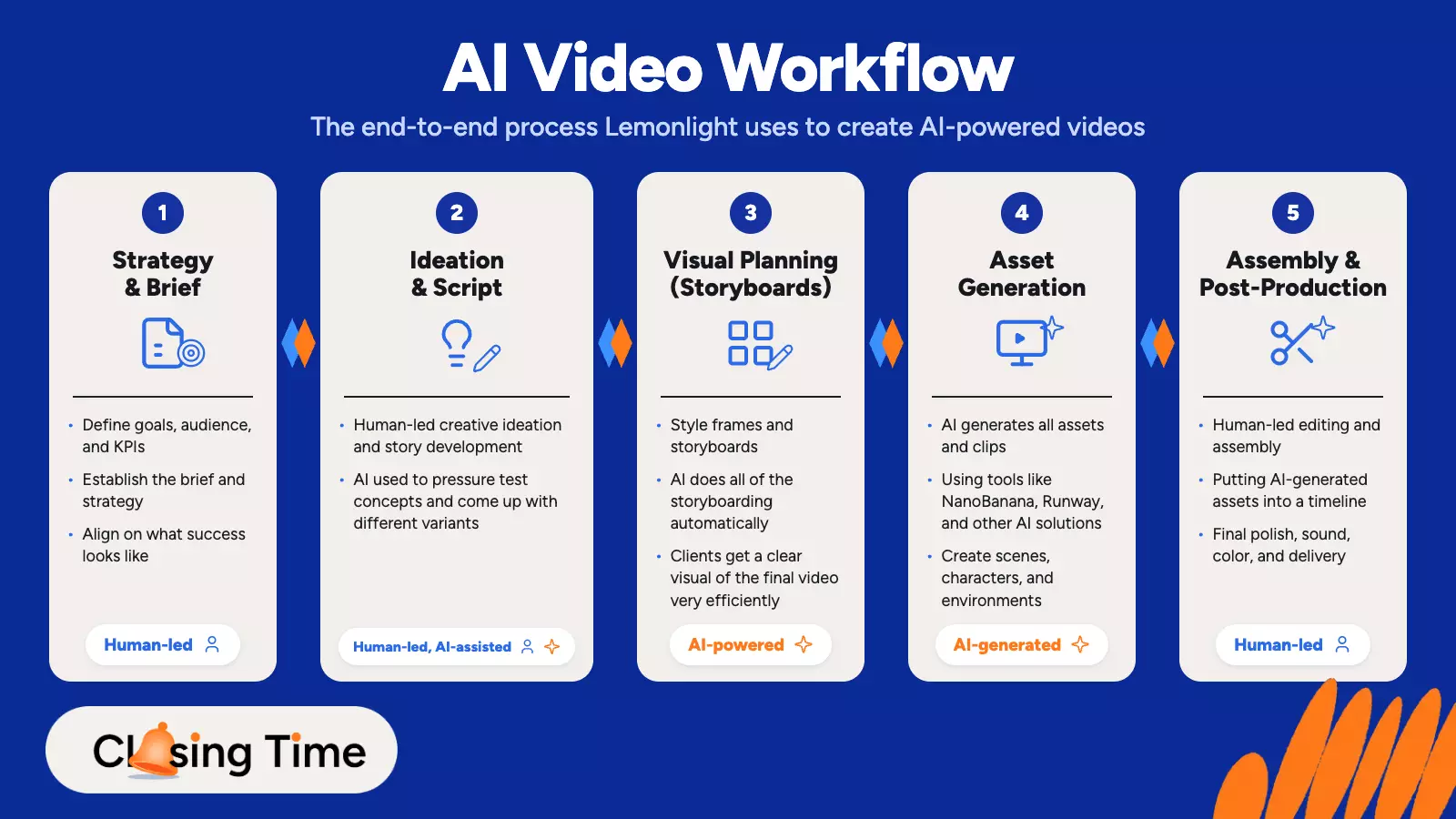
So it’s not that different actually than kind of traditional production workflows.
It’s just where the area is kind of able to jump in and assist
and create more efficiency.
So just like always, you’re starting with a brief and a strategy to determine
what the goal is who the audience is KPIs that you want to hit.
Next is ideation and script.
For us this is still very much human led but AI assisted.
So using AI to pressure test concepts to come up with different variance
pieces like that.
I would say the visual planning, which is like style frames
and storyboards is really where AI starts to make a big splash.
So for us, we built a platform called hero that basically does all of the GenAI
storyboarding.
Automatically, which has been a huge resource
for our clients to get a really clear understanding very efficiently with
exactly what their video is going to look like. In the end.
The asset generation is obviously AI, whether you’re using Nano Banana,
Runway or any of the myriad of options that come out seemingly weekly now.
You know, that’s where the assets are being created.
And then finally,
the actual assembly and post-production are still, for us, human led.
So actually taking those clips and putting them,
you know, into a timeline to make a full video.
I like how you accentuated the part where, storyboarding because sometimes I,
as a person who has purchased video before, you know,
you have this vision based on the storyboard and then,
you know, there’s such a big difference between the storyboard and,
you know, the day of the shoot.
So it sounds like you can really bridge that part
quite a bit better using AI.
Definitely.
I mean, for both live action production
and for GenAI videos,. I feel like the storyboard.
functionality has reached new highs.
Because they’re so easy to iterate on now.
So for Gen AI video, what you see in the storyboard is ultimately
exactly what you get in the actual video.
But even for live action productions, it’s so much easier
to create the storyboard image itself.
To inform the team that’s going to set.
And so you can really fine tune that with the client before
the production day ever begins.
Right. Yeah.
I just I mean, to me, as a consumer of, of of a purchase or a video production,
it just feels like. I’m not going to have any
as many surprises as I’ve had in the past.
That’s pretty amazing.
Yeah, that’s our hope.
So marketers always want to know, of course,
because we all are slaves to our budget.
What should I expect to pay?
So does AI video production
have a big impact on pricing versus traditional production?
And, are there real savings there?
So this is the number one question we get asked.
And everyone that asks
has wildly different understandings of what is real today and what is possible
and Can I click a button, get a video burst?
Can I actually have a video that’s going to work for my brand?
So, I’m glad you asked.
There’s a lot of noise in the market
that we have to kind of work through frequently.
For us at Lemonlight,
like a 30-second video costs somewhere between 2000 and, say, $20,000.
And that’s an extremely big range.
And then $20,000 may seem like a lot of money,
but if you’re comparing that to, say, a $1 million production
budget for a Super Bowl ad, that seems like an extraordinary deal.
But the price itself really comes down to complexity, right?
So if you are shooting a single product with two characters and a pretty common
house setting,
that can be pretty generic, that’s going to be closer to a $2,000 range
if you are shooting a highly complex scenes with large crowds and real world
environments that have to look exactly right or say, full fantasy worlds,
that’s where the budget can definitely get bigger.
But for us, the budget itself includes not only the asset generation
and all the AI costs, but also the human oversight
through that entire experience so that you understand
exactly what you’re getting and that ultimately
there’s someone behind measure ultimately looks exactly like your brand.
Yeah, I think to some folks that range might seem wide, but to a marketer
that doesn’t really seem that wide, because I do know as I’m going
into a project,
you know, the number of people, the number of scenes, the number of cuts,
the complexity, like so I think that’s actually a pretty fair range.
I’m going to validate you there.
Thank you.
And I also want to say, it’s
not that you can’t go online and click a button and get a video for $50.
Like that is a real.
But most
brands are looking for something that are just a little bit more high fidelity.
And so that’s a that’s the range that we work within.
Because we are creating higher quality content, it’s
usually being used to generate more customers for the customer.
Exactly.
So we you touched on this a little bit, but just to drive the point home,
where does AI genuinely shine in video
production and areas where it still might fall flat?
So kind of thinking like, what are some quick wins
that marketers could go after right now
where AI it really does help in that production process.
Yeah.
I think some of the areas that it does really well in
are like we talked about the previs and kind of pitch work.
Right.
If you’re pitching,
a client, your own client, you can do a lot of the work
using GenAI video to sort of get the concept across, clear,
any kind of stylized B-roll or kind of moody pieces.
What used to be stock footage is now generate video and a lot
more accurate to whatever it is you’re looking for,
because you can create it
instead of having to select what’s already been filmed.
Anything that’s like historical, fantastical or very difficult to shoot,
GenAI is going to be great for that, for all of the obvious reasons.
we produced a commercial with a skydiver recently.
Obviously, we did that with Gen AI because
filming a skydiver would be
very, expensive and hard.
A little scary too, right?
I’m sure insurance would not be okay with that.
Where it falls flat, though,
I think is definitely in the specific human performance element.
Right.
So nuanced acting, emotional driven dialog.
Anytime you need humans to really convey the message itself,
AI struggle with still, it’s great for kind of like VO-led videos.
And then the other area where we’re still seeing some struggles is
definitely, really complex products.
Think like a piece of medical device equipment or something like that.
That has to be really brand accurate.
There are still challenges with getting it to be perfect.
I do think that will get fixed
sooner than later, but that’s definitely a real challenge today.
And then I would say for quick wins right now,
you can use it to make tons of variants, right?
You can upload a long form video, click a button and get ten different outputs
that you can now use in organic social or across a variety of different mediums.
Using to AB test.
That’s a huge win.
If you’re creating a live action commercial or video, you can use AI to
do all of the kind of like, establishing shots or a lot of the kind of
generic B-roll shots that’s going to be a quick, easy win place to save.
And then also for,. I would say, like testing ideas in market.
So if you’re taking your concepts ahead of time to pressure test your market
or your audience, you can use AI videos to kind of do that quickly and iteratively.
To double click on the variant creation a little.
Is that something that a standard AI tool
that I might have access to like Claude or ChatGPT can do.
Or are there specialized video tools that your team has access to
that are specific to video production?
So Calude and ChatGPT to your team do not do this.
But there are very accessible tools in the market.
I would say one that we like is called. Get Munch.
You upload a long form video,
it will output a variety of different, short form pieces of content.
So that’s one there are a lot of variations of, of that, product.
So just a quick Google search should help you find some.
Yeah.
The click a button, get a great video, you know, may never really happen,
but if you had a look in your crystal ball and say, you know, in the future
where AI might be more effective, is there any spot that you see right
now, maybe a year from now, where we might be getting more from
AI than we’re getting right now?
I definitely believe we will be the way that we think about it, both on a short
and long term timeline is where humans stay is the judgement layer, in the taste.
So the dozens of little creative decisions that it takes to get from the beginning
of the product to the end of the product, giving the feedback nuanced
brand control, knowing when something is almost right versus actually right.
So that piece is very important today and I believe will continue
to be important forever.
I think what gets better and better is and what gets automated
is more of the labor.
So like we’ve talked about storyboards.
Call sheets get automatically generated.
That’s not a person having to create those anymore.
Instead of going on set to shoot, you do generate assets directly
instead of an assistant editor, taking time to prep all of the footage
and lay it out.. That can now be done by AI.
So I think the different labor components will continue
to get better and continue to save time.
I think the judgment and taste is what will remain
as extremely important for humans to be part of.
So is the Will Smith eating spaghetti?
Is that like something we should be checking in with annually
just to see how how much better it gets over time?
Because I know the early cuts are pretty rough.
they were pretty rough.
And I think OpenAI released a video,. I believe, remaking the eating spaghetti.
And obviously it was night and day different and really shows you
how far the industry has come, even in such a short, you know, time.
A couple of years.
Hope there might be some listeners out there who are on marketing teams
or leading marketing teams that have not done anything in relation to AI.
Video.
What would you say is a great first step for them?
Yeah. I’m.
I bet that’s a lot of a lot of folks.
So I would say the first step is to try it, you know, find a little bit of budget,
find either the right person on your team to pursue it
or the right partner to help you and commit a small amount of budget,
commit to doing it the right way, and been studying
the expectations on the front side
that this is not like click button a button, get a video.
It’s it’s, augmenting certain parts of the video creation process
and see what you come up with.
You know,
we’ve had great results with our clients who, you know, historically have shot,
you know, dozens of live action commercials throughout the year
who are now heavily, heavily relying on GenAI videos.
So it’s really about finding the right path for your team,
trying it once and then iterating on what worked and going from there.
All right.. That’s a really great first step.
Well, Hope, where can folks learn more about you?
Or a lemon light?
Yep. So you can find us at Lemonlight.com.
Thanks so much for joining us.
We appreciate your time.
Thank you so much, Val. Great to be here.
And if you would like to get this episode or every episode of Closing Time
delivered right to your inbox, just click the link in the show notes.
We will see you next time.