




We’re proclaiming 2026 as the year of the brand story, now powered by AI.
Let’s talk to a brand storytelling expert, in today’s
episode of Closing Time.
Thanks for tuning in to Closing Time, the show for go to Market Leaders.
I’m Val Riley, head of marketing for Insightly and Unbounce.
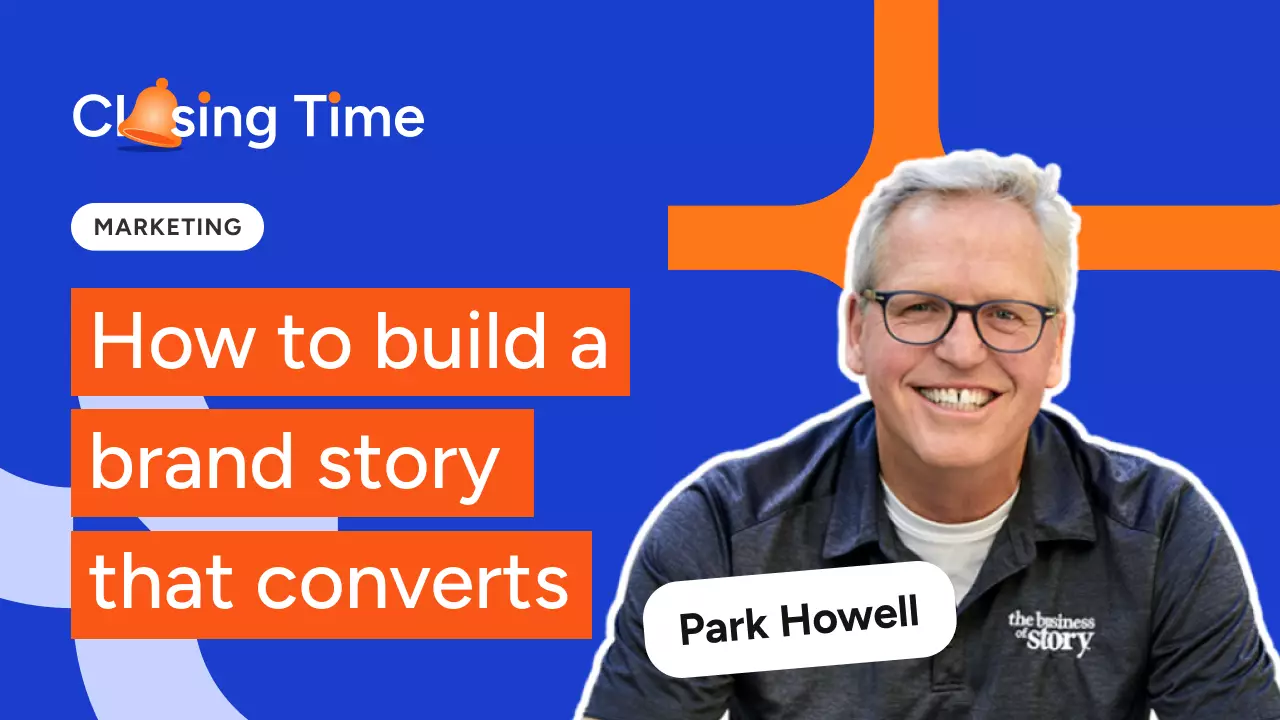
Today I’m joined by Park Howell.
He is author of Brand Bewitchery and the Narrative Gym
for Business, and a top ten podcaster.
Park, welcome to Closing Time.
Val, thank you so much for having me.
Park, to start off, what is brand
storytelling and why is it so important?
Well, if you aren’t telling your story clearly.
And that is just your story about your company,
about your product or service, your origin story, or whatever.
People will tell your story for you.
And it won’t be the story you intended
unless you intentionally feed them the story you want repeated.
That essentially is brand storytelling, because every business
is kind of wrapped into a brand in one way, shape or form.
And I use the word brand because we always want to hold some sort of position
in between the ears of our customers, you know, and their mental landscape.
And you can’t do that as a general business or general company
with a general offering.
You have to really define your brand story so that it sticks
and that it’s memorable for the people that you want to connect with.
And that includes colleagues, customers, and the communities you ultimately serve.
Well, that’s an excellent summary.
I have a feeling you’ve you’ve
maybe shared that with folks before, but thank Only like for 40 years, Val.
Appreciate that.
So somebody may have heard that,
Park, and think, well, that’s just sounds like a little woo woo.
You know, but there’s science behind it.
And, like, what is the science behind it?
Well, there is a lot of science behind it,
and there’s a lot of people that try to poke holes in the science.
But let’s put the science aside for a second.
Val, when you were done today with business, you were going to go home.
Or maybe you’re going to stop and have a cocktail or wine with someone.
And what are you going to do?
You are going to sit down and share your day.
Ask them about their day.
Maybe you’ve got something tumultuous happening
in your life you’re going to talk about and share that story.
They may do the same thing.
Maybe there’s a tremendous opportunity they have.
They’re going to share that story.
So we are by nature of being homo sapiens storytelling creatures.
You know, my but like to say we’re storytelling apes, essentially,
because storytelling is the only thing that separates us
from all the other organic organisms
that we know because we Homo sapiens think, plan,
organize, enact, and act in story.
And the best way to demonstrate that, say you were selling something.
So you go in and you share it with a prospect and you share a story
around it.
Well, that story is a fiction because they haven’t bought anything yet.
They haven’t put it into action. Right?
But once they do
and you deliver on the promises you made in that fictional account,
it becomes nonfiction and it becomes the truth.
It becomes what they are.
They become an active participant in your story.
So I like to throw all the neuroscience and that stuff
where our brain lights up and there’s lots of Intel on that.
And I’m no neuroscientist, but I just think about it
on a very practical level of we are telling stories all the time.
It’s just when we get in to business situations and organizational situations
where we think we need to lead with logic and reason
so that we sound smart, we come across smart.
Our products are the smart way to think when what our audience is really want
is that emotional pull of a story.
First, we sell to the heart and then we justify
or they will justify that purchase with their heads.
Logic and reason.
Wow. Powerful stuff there.
So let’s zero in on like, an actual story.
Like what a brand story might include.
And, you have a bit of a cheat sheet for folks out there.
So if they’re listening to this podcast
and they’re out for a walk or walking their dog or at the gym,
a quick way to remember is ABT: and, but,
and therefore.
So walk me through that ABT model because it’s a super good takeaway
for today’s listeners.
You bet.
And it’s great because yeah, if you’re walking your pooch out there,
just think of and, but, therefore it is a very simple messaging construct.
I did not invent, invent.
It’s been around literally since the beginning of recorded storytelling time.
Set up, problem resolution.
And you use it because there’s really three statements
within an and, but, therefore structure.
The first statement is your and statement of agreement.
It is sharing with your audience the shared vision of what they want
in the world.
Then you have the but statement of contradiction
and that is their frustration or whatever negative emotion
they are currently experiencing because they don’t have what they want.
There’s a problem, a gap, an obstacle, something
standing in their way from getting what they want.
That, therefore, is a statement of consequence.
It is now imagine how you’re going to feel, the elation you’re going to get
when you get your products or services
needed, through us, through the brand.
So it’s set up problem resolution.
We call it agreement, contradiction and consequence
because those are the three forces of story.
Agreement: Act one sets a stage.
Yes, this is what we want.
But here’s the plot twist.
Here’s the problem that you have not yet solved.
Therefore, let us show you the way forward with us.
Okay. Super easy to remember.
And as you know,. Unbounce is a landing page company.
And so I, we when we were talking initially about this episode,
I said, well, can we relate this to landing pages?
And I think your face lit up a little bit because you’re like, well, absolutely.
This is the structure of a landing page.
So talk us through that too, because it was really enlightening for me.
Okay. Yeah, great.
And for all of you listeners
and viewers out there, it’s a terrific way to test the and, but, therefore,
just go to your home page or landing page in your website
and see if you are doing what 90% of brands do.
And that is just pounding where the greatest brand
we got, the greatest product.
You just naturally going to buy from us because I mean, why wouldn’t you, right?
I want you to switch that from your audience’s point of view
using the and, but, therefore and write that landing page from their perspective.
And so the way you do that is here, the elements of an and, but,
therefore you want to first start with your audience.
Describe them right off the bat.
You know, give me for instance.
Well, Val, let’s do one for you.
That’s the easiest way to do it.
Let’s put you through the ABT.
Who would be, you know, who’s your number one audience?
We definitely want to talk to a marketer, either in a corporation or an agency
that is looking to generate more leads
and bring more leads into their sales funnel.
Okay.
So you just this will be the rough way to build it out,
and then you’d want to wordsmith it, bringing your own creativity.
So, I would start off with, you know, let’s just say with, as the chief
marketing officer at an ad agency, you’re going to say it right.
You’re just going to define that right there.
What do they want relative to what you have to offer?
They may not even know what you’re offering yet.
You’re foreshadowing their need for your offering by saying so you are the CMO.
What do they
They want to launch
their campaigns really fast and they want to get results quickly.
So if it’s a mistake, they can pivot.
Or if it’s good, they can double down.
Now, what is their negative emotion?
Let’s go to the.. But statement of contradiction.
But what are they feeling?
What’s the negative emotion there? They’re feeling?
Well, they might not want to invest in another tool, another software tool.
Or they might be hesitant to, you know, buy something else.
Overwhelmed is probably a good word.
And marketers are just. I mean we just get hit with so many tools.
Our tech stacks are growing rapidly all the time.
And there’s just, you know, you got to just be diligent about where you spend.
All right, so they’re hit with too many tools
that lead to expanding tech stacks.
so then finally you are going to help them solve this problem.
So therefore, how are they going to feel once they’ve resolved this problem?
You’re going to feel like you’re getting results fast.
And, you know, speed is is a language that marketers definitely speak.
So, So does that make them feel exhilarated?
Overjoyed?
They’ll feel valued And maybe energized.
Let’s say energized, energized and valued.
We’re going to give you two of them, because of what?
Because how have you helped solve their problem?
By doing what?
They’re, they’re launching their campaigns faster.
And they’re converting.. They’re converting.
They’re into them.
Into leads, leads into, more quickly.
They’re converting leads quickly.
Through your services. Yes.
Because you’re launching campaigns faster
and generating more leads. Yes.
And then what’s the name of your service?
Unbounce landing page builder.
I just quickly wrote this down,
and then you would definitely want to take this away.
And you had wordsmith it in your own brand voice and so forth.
But you’re going to say something, folks out here, this is the way you set it up.
You want to identify your audience.
So as a CMO of a robust ad agency, let’s throw a little,
you know,
a little, get even more specific and give them a little bit of kudos in there.
You want to, launch campaigns
faster and set and get results
so that you can make the changes you need for the most optimization or something.
Again, I’m winging it here, but you’re totally overwhelmed
because you are hit with too many tools
that lead to a mire of tech stacks that actually slow you down,
therefore feel energized and valued
when you can launch those campaigns faster and get to that ideal
customer quicker, and convert them using
the Unbounce landing page formula.
I feel so understood.
Well, good.
And it’s and that’s horrible writing right there.
But you would take that.
Now let me also take it one step deeper for your audiences.
So you’re always wanting to put your audience at the center of story.
That’s why you identify them first and foremost.
Foremost.
And you’re showing them
that you understand them and appreciate what they want
and why that’s needed, why you know, why that’s so important to them.
And then you demonstrate your empathy when you follow that,
but with a negative emotion.
But you’re overwhelmed and undervalued, because you are hit with.
And then here’s the problem.
So you start with that negative emotion.
Use the conjunction word of
because and there’s some really fascinating studies by Harvard
that indicate why the word because is so important when trying to get people
to change their behaviors.
It’s a cause and effect thing that leads speaks to our pattern
seeking, problem solving, decision making, buying limbic brain.
Because and then you state what the absolute problem is,
this overwhelm of tools in these mired in tech stacks that are slowing you down.
Now you have opened the story circle as to what the problem is,
and that limbic survival brain is saying, how do I solve that?
Therefore.
And and you don’t have to use the word therefore,
but I just want you to use it when you first write these out
to get the structure right, you could use so.
Quite often. I use the word now to build urgency.
Now you can feel energized and totally valued
because you know of what you’re going to do.
It’s not until the second clause in the therefore statement of consequence
that you actually introduce the brand in its offering.
You always want to keep that story framework
focused on what’s in it for your audience.
Every step of the way, until at the end of it, they just can’t die.
They’re just dying to hear what it is you do.
How do I do this? Boom.
Then you deliver that.
Then what I like to do
is I like to follow that with a short little anecdotal story,
something that shows what you are
doing by telling a real true story very well,
so that you are not making opinions and assertions about your offering,
but you’re showing the impact that you’ve made.
So you’ve you’ve actually used two story frameworks on there, the act
and then the five primal elements of a short story, basically an anecdote
after that.
Then you support it all with the logic and reason.
How do you do it?
What systems do you have?
What proprietary approach do you take?
But you don’t lead with the logic and reason.
You lead with the emotion of a story.
And that’s the best example. I could give to you right now.
On how that works.
Yeah I mean leading with empathy is always going to be so powerful.
So you’re, because once I felt understood
by the opening section of what you shared, my guard was down a little bit.
And I’m definitely then at that point interested in hearing more.
Well, Val, you make a very good point where I talk about
the three forces a story of agreement, contradiction and consequence.
When you build them right, you are building what I call
or sharing what. I call the three forces of trust building.
You are demonstrating that you understand your audience.
You’re showing that you appreciate what they want.
Why that’s important to them, and then you are showing your empathy on
why they don’t have it.
So they’re saying, wow, you get me.
You know me, you understand my problems.
Therefore what’s the way forward?
How can you help me?
So what we did just now
was super enlightening and it was just two humans talking to each other.
But we have to have the obligatory. AI question about how AI is changing
brand storytelling and what marketers are doing
to adopt to AI in storytelling.
What’s your point of view?
Yeah, I love this question because I was asked that the other day
on another podcast.
And question one is how is I changing storytelling?
It’s not.
Storytelling is the common.
It will be around forever.
So where we started, it’s where our ancestors navigated and survived
the savanna using storytelling and we are using those exact same
frameworks to navigate and survive this onslaught of AI and communication
and whatever.
It’s the storyteller who is changing.
And if you already know
how to apply these analog frameworks of the and, but,
therefore the five primal elements of a short story
for big impact and our ten step story cycle system.
If you know how to use these as at Homo sapiens storytelling ape
or creature, if you will, then you can use. AI to help amplify your impact.
You’re going to collaborate with it.
But if you don’t understand these frameworks and you just say
ask AI to do it, you don’t know if what it’s giving you
is really good or not, or just more of the AI slop coming out.
We’ve had tremendous success using AI in storytelling,
but it all starts first with our own innate knowledge
of what makes up a good story and how to tell it.
Gotcha.
So even that little exercise we did where the language wasn’t so great, but you.
I felt like you got the gist.
I wonder if we take that, feed it into. AI and see where it goes.
There could could be a shortcut Well, you could do it.
And if you go to Gen AI like a ChatGPT just ask it.
Say using Park Howell’s ABT narrative framework, rewrite the following.
You drop it in there and then it’ll give you a pretty good,
you know, close proximity of the ABT.
But you still have to understand the framework
because it’s going to make mistakes.
It’s going to make stuff up, hallucinate.
It’ll get you close.
But it does help you like, iterate on five different ABTs very, very quickly.
And then you take them away as, as the writer, you are, you
clean them up, and then you use them and, you know, wherever you need to use them.
Got it.
Okay.
So, you mentioned the story cycle genie.
If folks want to learn more about that and about you.
Where should they go?
Yeah.
Got a storycyclegenie.ai. And just a quick overview of what it is.
We have spent two years taking everything we know
about brand storytelling, our frameworks and all the Intel out of my book
Brand Bewitchery, as well as the Narrative Gym for business.
And we built this not an AI, we use a AI.
We built our own platform called Story. Cycle Genie.
It’s StoryCycleGenie.AI.
It resides on our, bright C platform.
So everything that you build inside of it is all narrative native.
And it’s built on all of our frameworks.
And then, we use AI to help expedite
the process, but is completely locked down from AI.
So no AI can access your Intel, nor any competitors can access your Intel.
And then it creates your brand brain first, and then all of your strategy
and your content that is always on brand because it’s written in your voice,
does not hallucinate.
It never makes a mistake on the ABTs and our other frameworks,
because we’ve taught it how to use it to collaborate with you,
the user and we just sent to you over, brand assessment.
We ran through the, the story cycle genie and your actual story
narrative based on our story cycle system.
What did you think of the output you got?
So I gotta say it.
It nailed it.
It was really good.
There were, you know, very few things that I would even nip or tuck.
So, we were we were pretty much blown away.
So thank you for that.
You also mentioned that people can get a little bit of taste
of what you can do using that free brand story grader on your website.
So we should definitely share that with the audience.
Yeah, that’s the same, same website, storycyclegenie.ai,
when you look down, there’s a red button that says access the genie, or there’s
a white button right next to it that says, get your free, brand story grade.
Click on that.
Put in your email, your, what is it?
Your name, email, and just the URL of your website.
And under 60s is going to give you a grade from A+ to F minus
and a 14 point storytelling assessment that validates what you’re doing
well, reveals gaps that you can easily fix, and it actually
even inspires you with new ways to think about your brand story.
All right, well, everybody get out there.
Use that free tool.
Get your report card and start 2026
off on the right foot with, the year of the brand story.
Park, can’t
thank you enough for joining us for so insightful and really practical.
Thank you Val. I appreciate it.
And thanks to all of you for tuning in to Closing Time.
Remember, you can get this episode in every episode
delivered right to your inbox if you click the link in the show notes.
Thank you so much and we’ll see you next week.